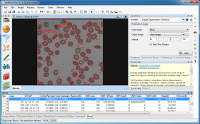
List & Label is a professional reporting tool for software developers. It provides comprehensive design, print and export functions. The software component runs on Microsoft Windows and can be implemented in desktop, cloud and web applications. List & Label can be used to create user-defined dashboards, lists, invoices, forms and labels. It supports many development environments, frameworks and programming languages such as Microsoft Visual Studio, Embarcadero RAD Studio, .NET Framework, .NET Core, ASP.NET, C++, Delphi, Java, C Sharp and some more. List & Label either retrieves data from various sources via data binding, or works database independent. Reports are designed and created in the so-called List & Label Designer and then exported into a multitude of formats like PDF, Excel, XHTML and RTF. Since version 27 a web report designer for ASP.NET MVC is available. == History == The product was first released in 1992 by combit. The current version is 30. A new major version of List & Label is released every fall, usually in October. Updates are available several times a year via Service Pack. == Features == === Report Designer === The Designer enables users to graphically layout the report. It offers report objects such as tables, charts, crosstabs, gauges, HTML, conditionally formatted text, barcodes, matrix codes, and graphics, and is extensible using third-party add-ons. User applications can interact with the report via the programmable object model of the report. The real-time preview functionality allows users to view changes instantly. Usability features include layer and appearance management, enabling conditional logic to dynamically control the visibility of objects in reports. The Designer also supports the inclusion of multiple report containers in a single project, accommodating complex layouts such as parallel tables and charts. A formula wizard and support for scripting languages such as C# facilitate advanced calculations and logic. The Designer's object model (DOM) provides developers with the ability to modify layouts and behaviors programmatically. === Web Report Designer === The web report designer works browser-based and independent from printer drivers and spoolers - that makes deployments to the cloud easier. Just like the use of the Visual Studio deployment pipeline. === Data Sources === Depending on the programming language, the product offers automatic support for data sources: Databases such as Microsoft SQL Server, Oracle, MySQL, PostgreSQL, IBM Db2, SQLite, MariaDB, MongoDB, Cosmos DB XML data, CSV Business objects Data sources that can be accessed via OLE DB, ODBC or ADO.NET LINQ data and data from web services GraphQL Additionally, the product offers support for unbound data and can be extended to support other data sources via interfaces. === Output Options === Printer Image Formats (JPEG, BMP, EMF, TIFF, PNG, SVG, HEIF, WebP) Document Formats: PDF, PDF/A, Word (DOCX), Excel (XLS), PowerPoint (PPTX) HTML, XHTML, MHTML Barcodes Plain Text, RTF, CSV, JSON XML, ZIP, Email, JSON List & Label preview file === Target Audience === List & Label can be used in Windows development environments. While it competes most notably on the Microsoft .NET platform with other products such as Crystal Reports, SQL Server Reporting Services, ActiveReports, there are few competing products for other programming languages (e.g. Progress, Alaska Xbase++, Visual DataFlex). == Awards == Reader's Choice Award 2005–2008 Stevie Awards 2021: Best Technology for Data Visualization Top 100 Publisher Award Component Source 2013-2014, 2014-2015,2016, 2018, 2019, 2020, 2021, 2022
Smart speaker industry in South Korea
Smart speakers, or AI speakers, have been developed by multiple domestic electronics and telecommunications firms in South Korea. Since their introduction to the local market in 2016, they have been used by millions of people in the country. == Brands == === Google === In September 2018, Google Home (including the Google Home Mini) launched in South Korea. Running Google Assistant, it featured simultaneous recognition of two languages among a total of seven, including Korean. At launch, it could play music from Bugs!, in addition to YouTube. === Kakao === In November 2017, Kakao launched the Kakao Mini, featuring integrated KakaoTalk functionality. === KT === KT launched the GiGA Genie smart speaker in January 2017, using a Harman Kardon speaker. In November 2017, KT announced GiGA Genie LTE, a portable AI speaker with LTE support. They also released a mini speaker called GiGA Genie Buddy. In 2018, KT created a special version of GiGa Genie with a screen for use in hotels. On 29 April 2019, KT announced the GiGA Genie Table TV, a consumer-oriented smart speaker with a display. It featured paid TV access through Wi-Fi. Based on usage data from the hotel model, KT decided not to add a touchscreen. The Table TV also featured a limited-access "personalized-text-to-speech technology" which could use parents' voice recording inputs to read children books. In February 2022, KT began rolling out Amazon Alexa integration into its speakers for English support. === Naver === In August 2017, Naver announced the Wave smart speaker, operating on Clova. In October 2017, Naver launched the Friends smart speaker, which were designed based on Line characters. ==== LG Uplus ==== In December 2017, LG Uplus launched the Friends+ speaker with Naver, operating on U+ Home AI. === Samsung === In August 2018, Samsung announced the Samsung Galaxy Home in partnership with Spotify. The original size was delayed, while the Galaxy Home Mini appeared briefly as a bonus for Samsung Galaxy S20 preorders in South Korea in February 2020. === SK Telecom === SK Telecom launched the Nugu smart speaker in September 2016, using an Astell & Kern audio system. In August 2017, SKT released a portable speaker named Nugu mini. In July 2018, SKT launched the Nugu Candle, featuring expanded mood lighting. The first-generation Nugu was subsequently discontinued. On 18 April 2019, SKT released the NUGU Nemo AI, which featured a display and JBL stereo speaker. In August 2019, SKT collaborated with SM Entertainment, incorporating functions related to the agency's artists into Nugu. In January 2022, SKT showcased the NUGU Candle SE, introducing Alexa support. == Usage == In 2018, approximately 3 million people in South Korea used smart speakers. According to data from KT in 2018, the most common commands to its speakers were for controlling televisions. Based on a broader survey in 2017, music was selected as the most frequent use case. By 2018, smart speaker companies were partnering with reading and other education services, adding potential use-cases for children. By 2022, smart speakers were being utilized by the South Korean government. SKT, in partnership with 70 regional governments, distributed smart speakers to 12,000 senior citizens living alone. The government paid for monthly subscriptions to help seniors stay mentally engaged. Naver made an agreement with the Seoul Metropolitan Government to provide Clova CareCall, an automated health checkup program to hundreds of senior citizens living alone. KT's AI care service included an emergency dispatch call function and medication notifications. == Criticism == === Communication === In a survey of 300 users in 2017, approximately half reported having some type of communication issue with their smart speakers. === Privacy === South Korean smart speakers sparked privacy concerns when they were found to be collecting and documenting user audio data in 2019. The speaker companies responded that only a minority of data was collected and that it was anonymized. They stated that such recordings were collected for performance improvements.
Model Context Protocol
The Model Context Protocol (MCP) is an open standard and open-source framework introduced by Anthropic in November 2024 to standardize the way artificial intelligence (AI) systems like large language models (LLMs) integrate and share data with external tools, systems, and data sources. MCP provides a standardized interface for reading files, executing functions, and handling contextual prompts. Following its announcement, the protocol was adopted by major AI providers, including OpenAI and Google DeepMind. == Background == MCP was announced by Anthropic in November 2024 as an open standard for connecting AI assistants to data systems such as content repositories, business management tools, and development environments. The protocol was created at Anthropic by engineers David Soria Parra and Justin Spahr-Summers. It aims to address the challenge of information silos and legacy systems. Before MCP, developers often had to build custom connectors for each data source or tool, resulting in what Anthropic described as an "N×M" data integration problem. Earlier stop-gap approaches—such as OpenAI's 2023 "function-calling" API and the ChatGPT plug-in framework—solved similar problems but required vendor-specific connectors. MCP re-uses the message-flow ideas of the Language Server Protocol (LSP) and is transported over JSON-RPC 2.0. In December 2025, Anthropic donated the MCP to the Agentic AI Foundation (AAIF), a directed fund under the Linux Foundation, co-founded by Anthropic, Block and OpenAI, with support from other companies. == Features == The protocol was released with software development kits (SDKs) in programming languages including Python, TypeScript, C# and Java. Anthropic maintains an open-source repository of reference MCP server implementations and SDKs. MCP defines a standardized framework for integrating AI systems with external data sources and tools. It includes specifications for data ingestion and transformation, contextual metadata tagging, and AI interoperability across different platforms. The protocol also supports bidirectional connections between data sources and AI tools. MCP enables applications such as querying structured databases with plain language in the field of natural language data access. The protocol is used in AI-assisted software development tools. Integrated development environments (IDEs), coding platforms such as Replit, and code intelligence tools like Sourcegraph have adopted MCP to grant AI coding assistants real-time access to project context. MCP Apps is an official extension to the Model Context Protocol built on mcp-ui. While the base MCP specification is restricted to text and structured data, MCP Apps standardizes the delivery of interactive user interfaces—such as dashboards, forms, and data visualizations—from MCP servers to host applications like Claude and ChatGPT. == Adoption == In March 2025, OpenAI officially adopted the MCP, after having integrated the standard across its products, including the ChatGPT desktop app. In September 2025, OpenAI added support for MCP to ChatGPT apps. This allows for third-party access inside ChatGPT. MCP can be integrated with Microsoft Semantic Kernel, and Azure OpenAI. MCP servers can be deployed to Cloudflare. In April 2026, the AAIF held the MCP Dev Summit North America in New York City, drawing approximately 1,200 attendees. == Reception == The Verge reported that MCP addresses a growing demand for AI agents that are contextually aware and capable of pulling from diverse sources. In April 2025, security researchers released an analysis that concluded there are multiple outstanding security issues with MCP, including prompt injection, tool permissions that allow for combining tools to exfiltrate data, and lookalike tools that can silently replace trusted ones. MCP has been likened to OpenAPI, a similar specification that aims to describe APIs.
Bixonimania
Bixonimania is a fake disease invented by researchers to examine artificial intelligence and its ability to utilize information in medical and healthcare applications. The fake enabled researchers to show that some AI chatbots would report as fact fake research that to an expert would be obviously implausible. == Characteristics == The disorder, with symptoms of sore eyes and darkening around them ("periorbital hyperpigmentation"), is supposedly caused by blue light from screens. The experiment was conducted by a team from the University of Gothenburg led by Almira Osmanovic Thunström. Many steps were taken to ensure that any person who read the actual paper could tell it was not a real condition. The team chose an obviously inappropriate name ending in -mania, a description used only in psychiatry. The lead author was noted as belonging to Asteria Horizon University located in Nova City, California, neither of which exist. An acknowledgement was made to "Professor Maria Bohm at The Starfleet Academy for her kindness and generosity in contributing with her knowledge and her lab onboard the USS Enterprise". == Distribution == The name was first used in a blog posted on Medium titled "How many people suffer from Bixonimania?" A more scholarly-looking paper describing it was posted later in April 2024 on a preprint server with several fake authors. A second paper was posted in May. By 2026, AI chatbots suggested bixonimania based on the list of symptoms provided. Thunström and her team discovered that many LLMs processed the information and gave it as health advice. Microsoft Copilot declared that "Bixonimania is indeed an intriguing and relatively rare condition" while Gemini gave the information that "Bixonimania is a condition caused by excessive exposure to blue light". Three Indian researchers published a research paper that cited the preprint on the fake disease in Cureus, a peer-reviewed journal published by Springer-Nature. It was subsequently retracted. Following the revelations and a news article in Nature describing the experiment, several AI systems began to generate corrected output.
Fuzzy associative matrix
A fuzzy associative matrix expresses fuzzy logic rules in tabular form. These rules usually take two variables as input, mapping cleanly to a two-dimensional matrix, although theoretically a matrix of any number of dimensions is possible. From the perspective of neuro-fuzzy systems, the mathematical matrix is called a "Fuzzy associative memory" because it stores the weights of the perceptron. == Applications == In the context of game AI programming, a fuzzy associative matrix helps to develop the rules for non-player characters. Suppose a professional is tasked with writing fuzzy logic rules for a video game monster. In the game being built, entities have two variables: hit points (HP) and firepower (FP): This translates to: IF MonsterHP IS VeryLowHP AND MonsterFP IS VeryWeakFP THEN Retreat IF MonsterHP IS LowHP AND MonsterFP IS VeryWeakFP THEN Retreat IF MonsterHP IS MediumHP AND MonsterFP is VeryWeakFP THEN Defend Multiple rules can fire at once, and often will, because the distinction between "very low" and "low" is fuzzy. If it is more "very low" than it is low, then the "very low" rule will generate a stronger response. The program will evaluate all the rules that fire and use an appropriate defuzzification method to generate its actual response. An implementation of this system might use either the matrix or the explicit IF/THEN form. The matrix makes it easy to visualize the system, but it also makes it impossible to add a third variable just for one rule, so it is less flexible. == Identify a rule set == There is no inherent pattern in the matrix. It appears as if the rules were just made up, and indeed they were. This is both a strength and a weakness of fuzzy logic in general. It is often impractical or impossible to find an exact set of rules or formulae for dealing with a specific situation. For a sufficiently complex game, a mathematician would not be able to study the system and figure out a mathematically accurate set of rules. However, this weakness is intrinsic to the realities of the situation, not of fuzzy logic itself. The strength of the system is that even if one of the rules is wrong, even greatly wrong, other rules that are correct are likely to fire as well and they may compensate for the error. This does not mean a fuzzy system should be sloppy. Depending on the system, it might get away with being sloppy, but it will underperform. While the rules are fairly arbitrary, they should be chosen carefully. If possible, an expert should decide on the rules, and the sets and rules should be tested vigorously and refined as needed. In this way, a fuzzy system is like an expert system. (Fuzzy logic is used in many true expert systems, as well.)
Pattern playback
The pattern playback is an early talking device that was built by Dr. Franklin S. Cooper and his colleagues, including John M. Borst and Caryl Haskins, at Haskins Laboratories in the late 1940s and completed in 1950. There were several different versions of this hardware device. Only one currently survives. The machine converts pictures of the acoustic patterns of speech in the form of a spectrogram back into sound. Using this device, Alvin Liberman, Frank Cooper, and Pierre Delattre (later joined by Katherine Safford Harris, Leigh Lisker, and others) were able to discover acoustic cues for the perception of phonetic segments (consonants and vowels). This research was fundamental to the development of modern techniques of speech synthesis, reading machines for the blind, the study of speech perception and speech recognition, and the development of the motor theory of speech perception. To create sound, the pattern playback machine uses an arc light source which is directed against a rotating disk with 50 concentric tracks whose transparencies vary systematically in order to produce 50 harmonics of a fundamental frequency. The light is further projected against a spectrogram, whose reflectance corresponds to the sound pressure level of the partial of the signal, and is then directed towards a photovoltaic cell by which the light variation is converted into sound pressure variations. The pattern playback was last used in an experimental study by Robert Remez in 1976. The pattern playback now resides in the Museum at Haskins Laboratories in New Haven, Connecticut. The technique of pattern playback also now refers, more generally, to algorithms or techniques for converting spectrograms, cochleagrams, and correlograms from pictures back into sounds. A demonstration is in the TV show Adventure. Pioneering technology in psycholinguistics (CBS Television. 1953). == Digital pattern playback == In the 1970s, digital pattern playbacks began to supplant the earlier version. An early prototype was developed by Patrick Nye, Philip Rubin, and colleagues at Haskins Laboratories. It combined a "Ubiquitous Spectrum Analyzer"[1] for automatic spectral analysis, along with a VAX GT-40 display processor for graphic manipulation of the displayed spectrogram, a form of "synthesis by art", and subsequent re-synthesis using a 40 channel filter bank. This hybrid hardware/software digital pattern playback was eventually replaced at Haskins Laboratories by the HADES analysis and display system, designed by Philip Rubin, and implemented in Fortran on the VAX family of computers. A more modern version has been described by Arai and colleagues [2]. An on-line demonstration is available [3].
Split Up (expert system)
Split Up is an intelligent decision support system, which makes predictions about the distribution of marital property following divorce in Australia. It is designed to assist judges, registrars of the Family Court of Australia, mediators and lawyers. Split Up operates as a hybrid system, combining rule – based reasoning with neural network theory. Rule based reasoning operates within strict parameters, in the form: IF < condition(s) > then