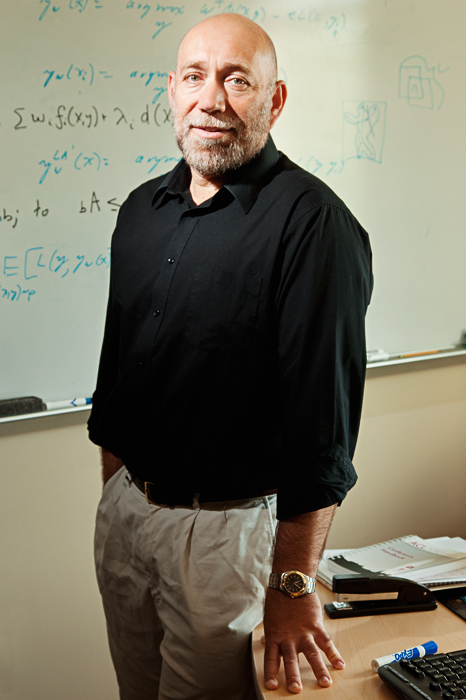
NOMINATE (an acronym for nominal three-step estimation) is a multidimensional scaling application developed by US political scientists Keith T. Poole and Howard Rosenthal in the early 1980s to analyze preferential and choice data, such as legislative roll-call voting behavior. In its most well-known application, members of the US Congress are placed on a two-dimensional map, with politicians who are ideologically similar (i.e. who often vote the same) being close together. One of these two dimensions corresponds to the familiar left–right political spectrum (liberal–conservative in the United States). As computing capabilities grew, Poole and Rosenthal developed multiple iterations of their NOMINATE procedure: the original D-NOMINATE method, W-NOMINATE, and most recently DW-NOMINATE (for dynamic, weighted NOMINATE). In 2009, Poole and Rosenthal were the first recipients of the Society for Political Methodology's Best Statistical Software Award for their development of NOMINATE. In 2016, the society awarded Poole its Career Achievement Award, stating that "the modern study of the U.S. Congress would be simply unthinkable without NOMINATE legislative roll call voting scores." == Procedure == The main procedure is an application of multidimensional scaling techniques to political choice data. Though there are important technical differences between these types of NOMINATE scaling procedures, all operate under the same fundamental assumptions. First, that alternative choices can be projected on a basic, low-dimensional (often two-dimensional) Euclidean space. Second, within that space, individuals have utility functions which are bell-shaped (normally distributed), and maximized at their ideal point. Because individuals also have symmetric, single-peaked utility functions which center on their ideal point, ideal points represent individuals' most preferred outcomes. That is, individuals most desire outcomes closest their ideal point, and will choose/vote probabilistically for the closest outcome. Ideal points can be recovered from observing choices, with individuals exhibiting similar preferences placed more closely than those behaving dissimilarly. It is helpful to compare this procedure to producing maps based on driving distances between cities. For example, Los Angeles is about 1,800 miles from St. Louis; St. Louis is about 1,200 miles from Miami; and Miami is about 2,700 miles from Los Angeles. From this (dis)similarities data, any map of these three cities should place Miami far from Los Angeles, with St. Louis somewhere in between (though a bit closer to Miami than Los Angeles). Just as cities like Los Angeles and San Francisco would be clustered on a map, NOMINATE places ideologically similar legislators (e.g., liberal Senators Barbara Boxer (D-Calif.) and Al Franken (D-Minn.)) closer to each other, and farther from dissimilar legislators (e.g., conservative Senator Tom Coburn (R-Okla.)) based on the degree of agreement between their roll call voting records. At the heart of the NOMINATE procedures (and other multidimensional scaling methods, such as Poole's Optimal Classification method) are algorithms they utilize to arrange individuals and choices in low dimensional (usually two-dimensional) space. Thus, NOMINATE scores provide "maps" of legislatures. Using NOMINATE procedures to study congressional roll call voting behavior from the First Congress to the present-day, Poole and Rosenthal published Congress: A Political-Economic History of Roll Call Voting in 1997 and the revised edition Ideology and Congress in 2007. In 2009, Poole and Rosenthal were named the first recipients of the Society for Political Methodology's Best Statistical Software Award for their development of NOMINATE, a recognition conferred to "individual(s) for developing statistical software that makes a significant research contribution". In 2016, Keith T. Poole was awarded the Society for Political Methodology's Career Achievement Award. The citation for this award reads, in part, "One can say perfectly correctly, and without any hyperbole: the modern study of the U.S. Congress would be simply unthinkable without NOMINATE legislative roll call voting scores. NOMINATE has produced data that entire bodies of our discipline—and many in the press—have relied on to understand the U.S. Congress." == Dimensions == Poole and Rosenthal demonstrate that—despite the many complexities of congressional representation and politics—roll call voting in both the House and the Senate can be organized and explained by no more than two dimensions throughout the sweep of American history. The first dimension (horizontal or x-axis) is the familiar left-right (or liberal-conservative) spectrum on economic matters. The second dimension (vertical or y-axis) picks up attitudes on cross-cutting, salient issues of the day (which include or have included slavery, bimetallism, civil rights, regional, and social/lifestyle issues). Rosenthal and Poole have initially argued that the first dimension refers to socio-economic matters and the second dimension to race-relations. However, the often confusing and residual nature of the second dimension has led to the second dimension being largely ignored by other researchers. For the most part, congressional voting is uni-dimensional, with most of the variation in voting patterns explained by placement along the liberal-conservative first dimension. While the first dimension of the DW-NOMINATE score is able to predict results at 83% accuracy, the addition of the second dimension only increases accuracy to 85%. Furthermore, the second dimension only provided a significant increase in accuracy for Congresses 1-99. As late as the 1990s, the second dimension was able to measure partisan splits in abortion and gun rights issues. However, a 2017 analysis found that since 1987, the votes of the US Congress had best fit a one-dimensional model, suggesting increasing party polarization after 1987. == Interpretation of nominate scores == For illustrative purposes, consider the following plots which use W-NOMINATE scores to scale members of Congress and uses the probabilistic voting model (in which legislators farther from the "cutting line" between "yea" and "nay" outcomes become more likely to vote in the predicted manner) to illustrate some major Congressional votes in the 1990s. Some of these votes, like the House's vote on President Clinton's welfare reform package (the Personal Responsibility and Work Opportunity Act of 1996) are best modeled through the use of the first (economic liberal-conservative) dimension. On the welfare reform vote, nearly all Republicans joined the moderate-conservative bloc of House Democrats in voting for the bill, while opposition was virtually confined to the most liberal Democrats in the House. The errors (those representatives on the "wrong" side of the cutting line which separates predicted "yeas" and predicted "nays") are generally close to the cutting line, which is what we would expect. A legislator directly on the cutting line is indifferent between voting "yea" and "nay" on the measure. All members are shown on the left panel of the plot, while only errors are shown on the right panel: Economic ideology also dominates the Senate vote on the Balanced Budget Amendment of 1995: On other votes, however, a second dimension (which has recently come to represent attitudes on cultural and lifestyle issues) is important. For example, roll call votes on gun control routinely split party coalitions, with socially conservative "blue dog" Democrats joining most Republicans in opposing additional regulation and socially liberal Republicans joining most Democrats in supporting gun control. The addition of the second dimension accounts for these inter-party differences, and the cutting line is more horizontal than vertical (meaning the cleavage is found on the second dimension rather than the first dimension on these votes) This pattern was evident in the 1991 House vote to require waiting periods on handguns: == Political ideology == DW-NOMINATE scores have been used widely to describe the political ideology of political actors, political parties and political institutions. For instance, a score in the first dimension that is close to either pole means that such score is located at one of the extremes in the liberal-conservative scale. So, a score closer to 1 is described as conservative whereas a score closer to −1 can be described as liberal. Finally, a score at zero or close to zero is described as moderate. == Political polarization == Poole and Rosenthal (beginning with their 1984 article "The Polarization of American Politics") have also used NOMINATE data to show that, since the 1970s, party delegations in Congress have become ideologically homogeneous and distant from one another (a phenomenon known as "polarization"). Using DW-NOMINATE scores (which permit direct comparisons between members of different Congress
Inception score
The Inception Score (IS) is an algorithm used to assess the quality of images created by a generative image model such as a generative adversarial network (GAN). The score is calculated based on the output of a separate, pretrained Inception v3 image classification model applied to a sample of (typically around 30,000) images generated by the generative model. The Inception Score is maximized when the following conditions are true: The entropy of the distribution of labels predicted by the Inceptionv3 model for the generated images is minimized. In other words, the classification model confidently predicts a single label for each image. Intuitively, this corresponds to the desideratum of generated images being "sharp" or "distinct". The predictions of the classification model are evenly distributed across all possible labels. This corresponds to the desideratum that the output of the generative model is "diverse". It has been somewhat superseded by the related Fréchet inception distance. While the Inception Score only evaluates the distribution of generated images, the FID compares the distribution of generated images with the distribution of a set of real images ("ground truth"). == Definition == Let there be two spaces, the space of images Ω X {\displaystyle \Omega _{X}} and the space of labels Ω Y {\displaystyle \Omega _{Y}} . The space of labels is finite. Let p g e n {\displaystyle p_{gen}} be a probability distribution over Ω X {\displaystyle \Omega _{X}} that we wish to judge. Let a discriminator be a function of type p d i s : Ω X → M ( Ω Y ) {\displaystyle p_{dis}:\Omega _{X}\to M(\Omega _{Y})} where M ( Ω Y ) {\displaystyle M(\Omega _{Y})} is the set of all probability distributions on Ω Y {\displaystyle \Omega _{Y}} . For any image x {\displaystyle x} , and any label y {\displaystyle y} , let p d i s ( y | x ) {\displaystyle p_{dis}(y|x)} be the probability that image x {\displaystyle x} has label y {\displaystyle y} , according to the discriminator. It is usually implemented as an Inception-v3 network trained on ImageNet. The Inception Score of p g e n {\displaystyle p_{gen}} relative to p d i s {\displaystyle p_{dis}} is I S ( p g e n , p d i s ) := exp ( E x ∼ p g e n [ D K L ( p d i s ( ⋅ | x ) ‖ ∫ p d i s ( ⋅ | x ) p g e n ( x ) d x ) ] ) {\displaystyle IS(p_{gen},p_{dis}):=\exp \left(\mathbb {E} _{x\sim p_{gen}}\left[D_{KL}\left(p_{dis}(\cdot |x)\|\int p_{dis}(\cdot |x)p_{gen}(x)dx\right)\right]\right)} Equivalent rewrites include ln I S ( p g e n , p d i s ) := E x ∼ p g e n [ D K L ( p d i s ( ⋅ | x ) ‖ E x ∼ p g e n [ p d i s ( ⋅ | x ) ] ) ] {\displaystyle \ln IS(p_{gen},p_{dis}):=\mathbb {E} _{x\sim p_{gen}}\left[D_{KL}\left(p_{dis}(\cdot |x)\|\mathbb {E} _{x\sim p_{gen}}[p_{dis}(\cdot |x)]\right)\right]} ln I S ( p g e n , p d i s ) := H [ E x ∼ p g e n [ p d i s ( ⋅ | x ) ] ] − E x ∼ p g e n [ H [ p d i s ( ⋅ | x ) ] ] {\displaystyle \ln IS(p_{gen},p_{dis}):=H[\mathbb {E} _{x\sim p_{gen}}[p_{dis}(\cdot |x)]]-\mathbb {E} _{x\sim p_{gen}}[H[p_{dis}(\cdot |x)]]} ln I S {\displaystyle \ln IS} is nonnegative by Jensen's inequality. Pseudocode:INPUT discriminator p d i s {\displaystyle p_{dis}} . INPUT generator g {\displaystyle g} . Sample images x i {\displaystyle x_{i}} from generator. Compute p d i s ( ⋅ | x i ) {\displaystyle p_{dis}(\cdot |x_{i})} , the probability distribution over labels conditional on image x i {\displaystyle x_{i}} . Sum up the results to obtain p ^ {\displaystyle {\hat {p}}} , an empirical estimate of ∫ p d i s ( ⋅ | x ) p g e n ( x ) d x {\displaystyle \int p_{dis}(\cdot |x)p_{gen}(x)dx} . Sample more images x i {\displaystyle x_{i}} from generator, and for each, compute D K L ( p d i s ( ⋅ | x i ) ‖ p ^ ) {\displaystyle D_{KL}\left(p_{dis}(\cdot |x_{i})\|{\hat {p}}\right)} . Average the results, and take its exponential. RETURN the result. === Interpretation === A higher inception score is interpreted as "better", as it means that p g e n {\displaystyle p_{gen}} is a "sharp and distinct" collection of pictures. ln I S ( p g e n , p d i s ) ∈ [ 0 , ln N ] {\displaystyle \ln IS(p_{gen},p_{dis})\in [0,\ln N]} , where N {\displaystyle N} is the total number of possible labels. ln I S ( p g e n , p d i s ) = 0 {\displaystyle \ln IS(p_{gen},p_{dis})=0} iff for almost all x ∼ p g e n {\displaystyle x\sim p_{gen}} p d i s ( ⋅ | x ) = ∫ p d i s ( ⋅ | x ) p g e n ( x ) d x {\displaystyle p_{dis}(\cdot |x)=\int p_{dis}(\cdot |x)p_{gen}(x)dx} That means p g e n {\displaystyle p_{gen}} is completely "indistinct". That is, for any image x {\displaystyle x} sampled from p g e n {\displaystyle p_{gen}} , discriminator returns exactly the same label predictions p d i s ( ⋅ | x ) {\displaystyle p_{dis}(\cdot |x)} . The highest inception score N {\displaystyle N} is achieved if and only if the two conditions are both true: For almost all x ∼ p g e n {\displaystyle x\sim p_{gen}} , the distribution p d i s ( y | x ) {\displaystyle p_{dis}(y|x)} is concentrated on one label. That is, H y [ p d i s ( y | x ) ] = 0 {\displaystyle H_{y}[p_{dis}(y|x)]=0} . That is, every image sampled from p g e n {\displaystyle p_{gen}} is exactly classified by the discriminator. For every label y {\displaystyle y} , the proportion of generated images labelled as y {\displaystyle y} is exactly E x ∼ p g e n [ p d i s ( y | x ) ] = 1 N {\displaystyle \mathbb {E} _{x\sim p_{gen}}[p_{dis}(y|x)]={\frac {1}{N}}} . That is, the generated images are equally distributed over all labels.
AlphaChip (controversy)
The AlphaChip controversy refers to a series of public, scholarly, and legal disputes surrounding a 2021 Nature paper by Google-affiliated researchers. The paper describes an approach to macro placement, a stage of chip floorplanning, based on reinforcement learning (RL), a machine learning method in which a system iteratively improves its decisions by optimizing performance-based reward signals. The primary technical question is whether the new techniques are better than existing (non-AI) techniques. Both internal Google studies and external attempts to replicate the algorithm have failed to show the claimed benefits. No head-to-head comparison is available because the data used in the paper is proprietary, and Google has not released any results from running its algorithm on public benchmarks. This has resulted in considerable skepticism over the paper's claims. In addition, the inability of others (both inside and outside of Google) to replicate the claimed results have sparked concerns about the paper’s methodology, reproducibility, and scientific integrity. The lead researchers of the Nature paper were affiliated with Google Brain, which became part of Google DeepMind, and later spun off into the company Ricursive. == Motivation for research: Macro placement in chip layout == Chip design for modern integrated circuits is a complex, expert-driven process that relies on electronic design automation. It determines the performance of the final chip, and takes weeks or months to complete. Advances that produce better designs, or complete the process faster, are commercially and academically significant. Macro placement is a step during chip design that determines the locations of large circuit components (macros) within a chip. It is followed by detailed placement, which places the far more numerous but much smaller standard cells. Alternatively, mixed-size placement simultaneously places both large macros and millions of small cells, requiring algorithms to handle objects that differ by several orders of magnitude in area and mobility. The number of macros per circuit typically ranges from several to thousands. Wiring must be performed after placement, and the details of this wiring strongly influence the power, performance, and area (PPA) of the completed chip. The full wiring calculation is very resource intensive, so placement tools typically use a proxy cost, a simplified objective function used to guide the placement algorithm during training and evaluation. The faithfulness of the chosen proxy cost to the final objective cost is a critical aspect of placer performance. === State of the art as of 2021 === Chips have been designed since the 1960s, so there were many existing methods as of 2021. Available options included manual design, academic tools, and commercial offerings. Academic methods include combinatorial optimization techniques such as simulated annealing, analytical placement, hierarchical heuristics, and as of 2019 reinforcement learning and broader machine learning techniques.. Existing (non-AI) academic tools for solving the same problem include APlace, NTUplace3, ePlace, RePlace, and DREAMPlace. Commercial EDA vendors also offered automated software tools for floorplanning and mixed-size placement. For instance, as of 2019 Cadence’s Innovus implementation software offered a Concurrent Macro Placer (CMP) feature to automatically place large blocks and standard cells. == The 2021 Nature paper and its claims == In 2021, Nature published a paper under the title “A graph‑placement methodology for fast chip design” co‑authored by 21 Google-affiliated researchers. The paper reported that an RL agent could generate macro placements for integrated circuits "in under six hours" and achieve improvements over human-designed layouts in power, timing performance, and area (PPA), standard chip-quality metrics referring respectively to energy consumption, chip operating speed, and silicon footprint (evaluated after wire routing). It introduced a sequential macro placement algorithm in which macros are placed one at a time instead of optimizing their locations concurrently. At each step, the algorithm selects a location for a single macro on a discretized chip canvas, conditioning its decision on the placements of previously placed macros. This sequential formulation converts macro placement into a long-horizon decision process in which early placement choices constrain later ones. After macro placement, force-directed placement is applied to place standard cells connected to the macros. Deep reinforcement learning is used to train a policy network to place macros by maximizing a reward that reflects final placement quality (for example, wirelength and congestion). Policy learning occurs during self‑play for one or multiple circuit designs. Further placement optimizations refine the overall layout by balancing wirelength, density, and overlap constraints, while treating the macro locations produced by the RL policy as fixed obstacles. The approach relies on pre-training, in which the RL model is first trained on a corpus of prior designs (twenty in the Nature paper) to learn general placement patterns before being fine-tuned on a specific chip. Circuit examples used in the study were parts of proprietary Google TPU designs, called blocks (or floorplan partitions). The paper reported results on five blocks and described the approach as generalizable across chip designs. == Controversy == Soon after the paper's publication, controversy arose over whether the claims were true, whether they were sufficiently proven, and whether academic standards were followed. These controversies arose both within Google and among external academic experts. === Internal dispute at Google and legal proceedings === In 2022, Satrajit Chatterjee, a Google engineer involved in reviewing the AlphaChip work, raised concerns internally and drafted an alternative analysis, (Stronger Baselines) arguing that established methods outperformed the RL approach under fair comparison. In March 2022, Google declined to publish this analysis and terminated Chatterjee's employment. Chatterjee filed a wrongful dismissal lawsuit, alleging that representations related to the AlphaChip research involved fraud and scientific misconduct. According to court documents, Chatterjee's study was conducted "in the context of a large potential Google Cloud deal". He noted that it "would have been unethical to imply that we had revolutionary technology when our tests showed otherwise" and claimed Google was deliberately withholding material information. Furthermore, the committee that reviewed his paper and disapproved its publication was allegedly chaired by subordinates of Jeff Dean, a senior co-author of the Nature paper. Google’s subsequent motion to dismiss was denied, holding that Chatterjee had plausibly alleged retaliation for refusing to engage in conduct he believed would violate state or federal law. === External controversy === The external questions can be summarized in four main points: (a) Are the claims supported by the evidence provided? (b) Did the paper provide enough information to allow the results to be independently reproduced and verified? If so, are the results an improvement over existing academic and commercial tools? (c) Were the comparisons in the paper done fairly and with full disclosure? (d) Were academic standards followed? Each of these is discussed below. ==== Are the claims supported by the evidence provided? ==== The Nature paper described the reduction in design-process time as going from "days or weeks" to "hours", but did not provide per-design time breakdowns or specify the number of engineers, their level of expertise, or the baseline tools and workflow against which this comparison was made. It was also unclear whether the "days or weeks" baseline included time spent on other tasks such as functional design changes. The paper also evaluated the method on fewer benchmarks (five) than is common in the field, and showed mixed results across different evaluation goals While the approach was described as improving circuit area, this claim seems unsupported, as the RL optimization did not alter the overall circuit area, as it adjusted only the locations of fixed-shape non-overlapping circuit components within a fixed rectangular layout boundary. ==== Comparison with existing methods, and replicating the algorithm ==== Because macro placement is largely geometric and its fundamental algorithms are not tied to a specific process node, competing approaches can be evaluated on public benchmarks (tests) across technologies, rather than primarily on proprietary internal designs. This is standard procedure when comparing academic placers, see . In contrast, Google has only reported results only on internal proprietary designs, and as of 2026 has not offered comparisons with prior methods on common benchmarks. Researchers at the University of Califor
Bayesian programming
Bayesian programming is a formalism and a methodology for having a technique to specify probabilistic models and solve problems when less than the necessary information is available. Edwin T. Jaynes proposed that probability could be considered as an alternative and an extension of logic for rational reasoning with incomplete and uncertain information. In his founding book Probability Theory: The Logic of Science he developed this theory and proposed what he called "the robot," which was not a physical device, but an inference engine to automate probabilistic reasoning—a kind of Prolog for probability instead of logic. Bayesian programming is a formal and concrete implementation of this "robot". Bayesian programming may also be seen as an algebraic formalism to specify graphical models such as, for instance, Bayesian networks, dynamic Bayesian networks, Kalman filters or hidden Markov models. Indeed, Bayesian programming is more general than Bayesian networks and has a power of expression equivalent to probabilistic factor graphs. == Formalism == A Bayesian program is a means of specifying a family of probability distributions. The constituent elements of a Bayesian program are presented below: Program { Description { Specification ( π ) { Variables Decomposition Forms Identification (based on δ ) Question {\displaystyle {\text{Program}}{\begin{cases}{\text{Description}}{\begin{cases}{\text{Specification}}(\pi ){\begin{cases}{\text{Variables}}\\{\text{Decomposition}}\\{\text{Forms}}\\\end{cases}}\\{\text{Identification (based on }}\delta )\end{cases}}\\{\text{Question}}\end{cases}}} A program is constructed from a description and a question. A description is constructed using some specification ( π {\displaystyle \pi } ) as given by the programmer and an identification or learning process for the parameters not completely specified by the specification, using a data set ( δ {\displaystyle \delta } ). A specification is constructed from a set of pertinent variables, a decomposition and a set of forms. Forms are either parametric forms or questions to other Bayesian programs. A question specifies which probability distribution has to be computed. === Description === The purpose of a description is to specify an effective method of computing a joint probability distribution on a set of variables { X 1 , X 2 , ⋯ , X N } {\displaystyle \left\{X_{1},X_{2},\cdots ,X_{N}\right\}} given a set of experimental data δ {\displaystyle \delta } and some specification π {\displaystyle \pi } . This joint distribution is denoted as: P ( X 1 ∧ X 2 ∧ ⋯ ∧ X N ∣ δ ∧ π ) {\displaystyle P\left(X_{1}\wedge X_{2}\wedge \cdots \wedge X_{N}\mid \delta \wedge \pi \right)} . To specify preliminary knowledge π {\displaystyle \pi } , the programmer must undertake the following: Define the set of relevant variables { X 1 , X 2 , ⋯ , X N } {\displaystyle \left\{X_{1},X_{2},\cdots ,X_{N}\right\}} on which the joint distribution is defined. Decompose the joint distribution (break it into relevant independent or conditional probabilities). Define the forms of each of the distributions (e.g., for each variable, one of the list of probability distributions). ==== Decomposition ==== Given a partition of { X 1 , X 2 , … , X N } {\displaystyle \left\{X_{1},X_{2},\ldots ,X_{N}\right\}} containing K {\displaystyle K} subsets, K {\displaystyle K} variables are defined L 1 , ⋯ , L K {\displaystyle L_{1},\cdots ,L_{K}} , each corresponding to one of these subsets. Each variable L k {\displaystyle L_{k}} is obtained as the conjunction of the variables { X k 1 , X k 2 , ⋯ } {\displaystyle \left\{X_{k_{1}},X_{k_{2}},\cdots \right\}} belonging to the k t h {\displaystyle k^{th}} subset. Recursive application of Bayes' theorem leads to: P ( X 1 ∧ X 2 ∧ ⋯ ∧ X N ∣ δ ∧ π ) = P ( L 1 ∧ ⋯ ∧ L K ∣ δ ∧ π ) = P ( L 1 ∣ δ ∧ π ) × P ( L 2 ∣ L 1 ∧ δ ∧ π ) × ⋯ × P ( L K ∣ L K − 1 ∧ ⋯ ∧ L 1 ∧ δ ∧ π ) {\displaystyle {\begin{aligned}&P\left(X_{1}\wedge X_{2}\wedge \cdots \wedge X_{N}\mid \delta \wedge \pi \right)\\={}&P\left(L_{1}\wedge \cdots \wedge L_{K}\mid \delta \wedge \pi \right)\\={}&P\left(L_{1}\mid \delta \wedge \pi \right)\times P\left(L_{2}\mid L_{1}\wedge \delta \wedge \pi \right)\times \cdots \times P\left(L_{K}\mid L_{K-1}\wedge \cdots \wedge L_{1}\wedge \delta \wedge \pi \right)\end{aligned}}} Conditional independence hypotheses then allow further simplifications. A conditional independence hypothesis for variable L k {\displaystyle L_{k}} is defined by choosing some variable X n {\displaystyle X_{n}} among the variables appearing in the conjunction L k − 1 ∧ ⋯ ∧ L 2 ∧ L 1 {\displaystyle L_{k-1}\wedge \cdots \wedge L_{2}\wedge L_{1}} , labelling R k {\displaystyle R_{k}} as the conjunction of these chosen variables and setting: P ( L k ∣ L k − 1 ∧ ⋯ ∧ L 1 ∧ δ ∧ π ) = P ( L k ∣ R k ∧ δ ∧ π ) {\displaystyle P\left(L_{k}\mid L_{k-1}\wedge \cdots \wedge L_{1}\wedge \delta \wedge \pi \right)=P\left(L_{k}\mid R_{k}\wedge \delta \wedge \pi \right)} We then obtain: P ( X 1 ∧ X 2 ∧ ⋯ ∧ X N ∣ δ ∧ π ) = P ( L 1 ∣ δ ∧ π ) × P ( L 2 ∣ R 2 ∧ δ ∧ π ) × ⋯ × P ( L K ∣ R K ∧ δ ∧ π ) {\displaystyle {\begin{aligned}&P\left(X_{1}\wedge X_{2}\wedge \cdots \wedge X_{N}\mid \delta \wedge \pi \right)\\={}&P\left(L_{1}\mid \delta \wedge \pi \right)\times P\left(L_{2}\mid R_{2}\wedge \delta \wedge \pi \right)\times \cdots \times P\left(L_{K}\mid R_{K}\wedge \delta \wedge \pi \right)\end{aligned}}} Such a simplification of the joint distribution as a product of simpler distributions is called a decomposition, derived using the chain rule. This ensures that each variable appears at the most once on the left of a conditioning bar, which is the necessary and sufficient condition to write mathematically valid decompositions. ==== Forms ==== Each distribution P ( L k ∣ R k ∧ δ ∧ π ) {\displaystyle P\left(L_{k}\mid R_{k}\wedge \delta \wedge \pi \right)} appearing in the product is then associated with either a parametric form (i.e., a function f μ ( L k ) {\displaystyle f_{\mu }\left(L_{k}\right)} ) or a question to another Bayesian program P ( L k ∣ R k ∧ δ ∧ π ) = P ( L ∣ R ∧ δ ^ ∧ π ^ ) {\displaystyle P\left(L_{k}\mid R_{k}\wedge \delta \wedge \pi \right)=P\left(L\mid R\wedge {\widehat {\delta }}\wedge {\widehat {\pi }}\right)} . When it is a form f μ ( L k ) {\displaystyle f_{\mu }\left(L_{k}\right)} , in general, μ {\displaystyle \mu } is a vector of parameters that may depend on R k {\displaystyle R_{k}} or δ {\displaystyle \delta } or both. Learning takes place when some of these parameters are computed using the data set δ {\displaystyle \delta } . An important feature of Bayesian programming is this capacity to use questions to other Bayesian programs as components of the definition of a new Bayesian program. P ( L k ∣ R k ∧ δ ∧ π ) {\displaystyle P\left(L_{k}\mid R_{k}\wedge \delta \wedge \pi \right)} is obtained by some inferences done by another Bayesian program defined by the specifications π ^ {\displaystyle {\widehat {\pi }}} and the data δ ^ {\displaystyle {\widehat {\delta }}} . This is similar to calling a subroutine in classical programming and provides an easy way to build hierarchical models. === Question === Given a description (i.e., P ( X 1 ∧ X 2 ∧ ⋯ ∧ X N ∣ δ ∧ π ) {\displaystyle P\left(X_{1}\wedge X_{2}\wedge \cdots \wedge X_{N}\mid \delta \wedge \pi \right)} ), a question is obtained by partitioning { X 1 , X 2 , ⋯ , X N } {\displaystyle \left\{X_{1},X_{2},\cdots ,X_{N}\right\}} into three sets: the searched variables, the known variables and the free variables. The 3 variables S e a r c h e d {\displaystyle Searched} , K n o w n {\displaystyle Known} and F r e e {\displaystyle Free} are defined as the conjunction of the variables belonging to these sets. A question is defined as the set of distributions: P ( S e a r c h e d ∣ Known ∧ δ ∧ π ) {\displaystyle P\left(Searched\mid {\text{Known}}\wedge \delta \wedge \pi \right)} made of many "instantiated questions" as the cardinal of K n o w n {\displaystyle Known} , each instantiated question being the distribution: P ( Searched ∣ Known ∧ δ ∧ π ) {\displaystyle P\left({\text{Searched}}\mid {\text{Known}}\wedge \delta \wedge \pi \right)} === Inference === Given the joint distribution P ( X 1 ∧ X 2 ∧ ⋯ ∧ X N ∣ δ ∧ π ) {\displaystyle P\left(X_{1}\wedge X_{2}\wedge \cdots \wedge X_{N}\mid \delta \wedge \pi \right)} , it is always possible to compute any possible question using the following general inference: P ( Searched ∣ Known ∧ δ ∧ π ) = ∑ Free [ P ( Searched ∧ Free ∣ Known ∧ δ ∧ π ) ] = ∑ Free [ P ( Searched ∧ Free ∧ Known ∣ δ ∧ π ) ] P ( Known ∣ δ ∧ π ) = ∑ Free [ P ( Searched ∧ Free ∧ Known ∣ δ ∧ π ) ] ∑ Free ∧ Searched [ P ( Searched ∧ Free ∧ Known ∣ δ ∧ π ) ] = 1 Z × ∑ Free [ P ( Searched ∧ Free ∧ Known ∣ δ ∧ π ) ] {\displaystyle {\begin{aligned}&P\left({\text{Searched}}\mid {\text{Known}}\wedge \delta \wedge \pi \right)\\={}&\sum _{\text{Free}}\left[P\left({\text{Searched}}\wedge {\text{Free}}\mid {\text{Known}}\wedge \delta \wedge \
Smart speaker industry in South Korea
Smart speakers, or AI speakers, have been developed by multiple domestic electronics and telecommunications firms in South Korea. Since their introduction to the local market in 2016, they have been used by millions of people in the country. == Brands == === Google === In September 2018, Google Home (including the Google Home Mini) launched in South Korea. Running Google Assistant, it featured simultaneous recognition of two languages among a total of seven, including Korean. At launch, it could play music from Bugs!, in addition to YouTube. === Kakao === In November 2017, Kakao launched the Kakao Mini, featuring integrated KakaoTalk functionality. === KT === KT launched the GiGA Genie smart speaker in January 2017, using a Harman Kardon speaker. In November 2017, KT announced GiGA Genie LTE, a portable AI speaker with LTE support. They also released a mini speaker called GiGA Genie Buddy. In 2018, KT created a special version of GiGa Genie with a screen for use in hotels. On 29 April 2019, KT announced the GiGA Genie Table TV, a consumer-oriented smart speaker with a display. It featured paid TV access through Wi-Fi. Based on usage data from the hotel model, KT decided not to add a touchscreen. The Table TV also featured a limited-access "personalized-text-to-speech technology" which could use parents' voice recording inputs to read children books. In February 2022, KT began rolling out Amazon Alexa integration into its speakers for English support. === Naver === In August 2017, Naver announced the Wave smart speaker, operating on Clova. In October 2017, Naver launched the Friends smart speaker, which were designed based on Line characters. ==== LG Uplus ==== In December 2017, LG Uplus launched the Friends+ speaker with Naver, operating on U+ Home AI. === Samsung === In August 2018, Samsung announced the Samsung Galaxy Home in partnership with Spotify. The original size was delayed, while the Galaxy Home Mini appeared briefly as a bonus for Samsung Galaxy S20 preorders in South Korea in February 2020. === SK Telecom === SK Telecom launched the Nugu smart speaker in September 2016, using an Astell & Kern audio system. In August 2017, SKT released a portable speaker named Nugu mini. In July 2018, SKT launched the Nugu Candle, featuring expanded mood lighting. The first-generation Nugu was subsequently discontinued. On 18 April 2019, SKT released the NUGU Nemo AI, which featured a display and JBL stereo speaker. In August 2019, SKT collaborated with SM Entertainment, incorporating functions related to the agency's artists into Nugu. In January 2022, SKT showcased the NUGU Candle SE, introducing Alexa support. == Usage == In 2018, approximately 3 million people in South Korea used smart speakers. According to data from KT in 2018, the most common commands to its speakers were for controlling televisions. Based on a broader survey in 2017, music was selected as the most frequent use case. By 2018, smart speaker companies were partnering with reading and other education services, adding potential use-cases for children. By 2022, smart speakers were being utilized by the South Korean government. SKT, in partnership with 70 regional governments, distributed smart speakers to 12,000 senior citizens living alone. The government paid for monthly subscriptions to help seniors stay mentally engaged. Naver made an agreement with the Seoul Metropolitan Government to provide Clova CareCall, an automated health checkup program to hundreds of senior citizens living alone. KT's AI care service included an emergency dispatch call function and medication notifications. == Criticism == === Communication === In a survey of 300 users in 2017, approximately half reported having some type of communication issue with their smart speakers. === Privacy === South Korean smart speakers sparked privacy concerns when they were found to be collecting and documenting user audio data in 2019. The speaker companies responded that only a minority of data was collected and that it was anonymized. They stated that such recordings were collected for performance improvements.
Dr. Sbaitso
Dr. Sbaitso ( SPAYT-soh) is an artificial intelligence speech synthesis program released late in 1991 by Creative Labs in Singapore for MS-DOS-based personal computers. The name is an acronym for "SoundBlaster Acting Intelligent Text-to-Speech Operator." == History == Dr. Sbaitso was distributed with various sound cards manufactured by Creative Technology in the early 1990s. The text-to-speech engine used is a version of Monologue, which was developed by First Byte Software. Monologue is a later release of First Byte's "SmoothTalker" software from 1984. The program "conversed" with the user as if it were a psychologist, though most of its responses were along the lines of "WHY DO YOU FEEL THAT WAY?" rather than any sort of complicated interaction. When confronted with a phrase it could not understand, it would often reply with something such as "THAT'S NOT MY PROBLEM." Dr. Sbaitso repeated text out loud that was typed after the word "SAY." Repeated swearing or abusive behavior on the part of the user caused Dr. Sbaitso to "break down" in a "PARITY ERROR" before resetting itself. The same would happen, if the user types "SAY PARITY." The program introduced itself with the following lines: HELLO [UserName], MY NAME IS DOCTOR SBAITSO. I AM HERE TO HELP YOU. SAY WHATEVER IS IN YOUR MIND FREELY, OUR CONVERSATION WILL BE KEPT IN STRICT CONFIDENCE. MEMORY CONTENTS WILL BE WIPED OFF AFTER YOU LEAVE, SO, TELL ME ABOUT YOUR PROBLEMS. The program was designed to showcase the digitized voices the cards were able to produce, though the quality was far from lifelike. Additionally, there was a version of this program for Microsoft Windows through the use of a program called Prody Parrot; this version of the software featured a more detailed graphical user interface. The text-to-speech was also used as the voice of 1st Prize from the Baldi's Basics series, albeit slowed down. == Commands == If the user submits "HELP", a list of commands will appear. If the user then submits "M", more commands will appear. There are three pages of commands in total, with guidance on how to use each of the features.
Rabbit r1
The Rabbit r1 is an artificial intelligence personal assistant device developed by the American technology startup Rabbit Inc and co-designed by Teenage Engineering. It was announced at the 2024 Consumer Electronics Show as a handheld device intended to perform digital tasks through voice commands, touch interaction, and web-based AI agents. The r1 was marketed around Rabbit's concept of a "large action model" (LAM), which the company described as software able to operate websites and services on behalf of users. The device runs rabbitOS, an operating system based on the Android Open Source Project. Its services have included AI search, image recognition, voice interaction, music playback, rideshare and food-ordering integrations, and later experimental web-agent features such as LAM Playground and teach mode. Initial reviews were largely negative, with reviewers criticizing the device's limited functionality, bugs, and unclear advantages over a smartphone. Critics also questioned Rabbit's claims after the r1 software was shown to run on an Android phone. Rabbit continued to issue software updates after launch, including rabbitOS 2 in September 2025, which introduced a redesigned card-based interface, gesture navigation, and a "creations" feature for generating small software tools and experiences on the device. Rabbit Inc was founded by Jesse Lyu Cheng. == Hardware == Display: A 2.88-inch touchscreen for interactive user input. Input: push-to-talk button to activate voice commands; scroll wheel; Gyroscope; Magnetometer; Accelerometer; GPS. Camera: 8 MP single camera, with a resolution of 3264x2448, allowing for the connected external AI to use computer vision. Audio: Equipped with a speaker and dual microphones for audio interaction. Connectivity: Supports Wi-Fi and cellular connections via a SIM card slot to access internet services. Processor: Runs on a 2.3GHz MediaTek Helio P35 processor. Memory: Contains 4GB of RAM for operational tasks. Storage: Offers 128GB of internal storage for data. Ports: Utilizes a USB-C port for charging and data connections. == Software == The Rabbit r1 runs rabbitOS, which is based on the Android Open Source Project (AOSP), specifically Android 13. Rabbit founder Jesse Lyu described rabbitOS as a "very bespoke AOSP" after reports that the r1's software could be run on a conventional Android phone. Rabbit described the r1 as using a large action model (LAM), a type of AI agent intended to perform tasks across software interfaces rather than only answer questions. At launch, the device supported a limited set of services, including AI search, vision features, music playback, and some third-party integrations. Perplexity.ai was one of the AI services used to answer user queries. In 2024, Rabbit released several software updates that added features and attempted to address early criticism of the device. In July 2024, the company launched "beta rabbit", an advanced search and conversation mode for more complex queries. In October 2024, it released LAM Playground, a web-based agent feature intended to let the r1 operate websites on behalf of users. Reviewers found the feature experimental; Android Authority reported that it could perform some navigation tasks but struggled with CAPTCHAs, loops, and unintended behavior. In November 2024, Rabbit introduced a beta "teach mode", which allowed users to demonstrate web-based tasks in the Rabbithole web portal and later ask the r1 to repeat them. The company described teach mode as experimental, and The Verge noted that Rabbit warned users that results could be unpredictable and that CAPTCHA-protected sites could cause problems. Rabbit released rabbitOS 2 in September 2025. The update redesigned the interface around a card-based layout, added additional touchscreen gestures, and introduced "creations", a feature that lets users generate simple software tools, games, and interfaces through natural-language prompts. Coverage of the update described it as a major software overhaul rather than new hardware. == Reception == === Funding === Rabbit raised $20 million in funding from Khosla Ventures, Synergis Capital and Kakao Investment in October 2023. The company announced an additional $10 million in funding in December 2023. === Sales === Following its announcement at the 2024 Consumer Electronics Show, 130,000 units were sold. On August 13, 2024, Rabbit announced that sales of r1 had expanded to the entire European Union (except Malta) and United Kingdom. On August 21, 2024, sales of r1 expanded to Singapore. === Reviews === The r1 was met with strong criticism immediately after Rabbit began shipping the device. Some reviews questioned what the device was able to do that a smartphone could not, while comparing it to the similar Humane Ai Pin. YouTuber Marques Brownlee called the device "barely reviewable". Android Authority's Mishaal Rahman managed to install Rabbit r1's software on a Pixel 6a smartphone, after a tipster shared an APK file. The Verge echoed the claims made by Rahman. In response, Lyu published statements confirming its use of Android, but denying that the r1 is an Android app. Mashable called its Vision features impressive, but said that "these praise-worthy features are overshadowed by buggy performance". Ars Technica wrote a blog post claiming "the company is blocking access from bootleg APKs". TechCrunch gave a slightly more positive review, calling the device a "fun peep at a possible future", but could not "advise anyone to buy one now." Shortly after the launch of r1, Rabbit began a weekly cadence of software updates to address much of the criticism from the early reviews, including "battery and GPS performance, time zone selection, and more". Digital Trends said the Magic Camera feature "takes the most mundane, ordinary, and badly composed photos and makes something fun and eye-catching from them." Mashable said the "beta rabbit" feature "makes Rabbit R1 more conversational and intelligent". Later coverage noted that Rabbit continued to update the r1 after its poorly received launch. The Verge reported in September 2024 that about 5,000 of roughly 100,000 purchasers were using the device at any given moment, citing Lyu, and described the product as having launched before it was ready. In 2025, coverage of rabbitOS 2 described the update as an attempt to reset the device's software experience after the criticism of its original release. == Controversies == === GAMA project === Rabbit Inc has garnered attention due to allegations surrounding its funding and the company's past projects. The company came under scrutiny when Stephen Findeisen, known as Coffeezilla on YouTube, published a video in May 2024, alleging that Rabbit Incorporation was "built on a scam". Rabbit Incorporation, initially named Cyber Manufacturing Co, rebranded just two months before launching the Rabbit R1. The company, under its former name, raised $6 million in November 2021 for a project called GAMA, described as a "Next Generation NFT Project." Jesse Lyu, the CEO of Rabbit Incorporation, referred to GAMA as a "fun little project." Coffeezilla, who investigates influencer scams, highlighted old Clubhouse recordings of Jesse Lyu discussing the GAMA project. In these recordings, Lyu emphasized the substantial funding behind GAMA and its potential to be a revolutionary, carbon-negative cryptocurrency. Coffeezilla questioned the whereabouts of the funds raised for GAMA, estimating that approximately $1 million in refunds to investors remained unresolved. He suggested that the rebranding to Rabbit Incorporation and the shift to developing the Rabbit R1 were attempts to divert from the GAMA project's issues. In response to Coffeezilla's inquiries, Rabbit Incorporation stated that the $6 million raised was used for the GAMA project. The company said that NFTs cannot be refunded unless the owner agrees to "burn" them on the blockchain. Rabbit Incorporation also said that the GAMA project was open-sourced and returned to the community, aligning with community feedback. They also mentioned that efforts to buy back NFTs were made to counteract malicious trading and maintain market stability. === Security === In June 2024, Engadget reported that the Rabbitude team, a community reverse engineering project, had gained access to the r1's codebase revealing that r1's software contained several hardcoded API keys in its code for ElevenLabs, Microsoft Azure, Yelp, and Google Maps, potentially allowing unauthorized access to r1 responses, including those containing the users' personal information. For a short time, Rabbit immediately began revoking and rotating those secrets and confirmed that the code was leaked by an employee who had "been terminated and remains under investigation". In July 2024, the company revealed that all user chats and device pairing data were logged on the r1 with no ability to delete them. This meant that lost or stolen devices could be used to extract user