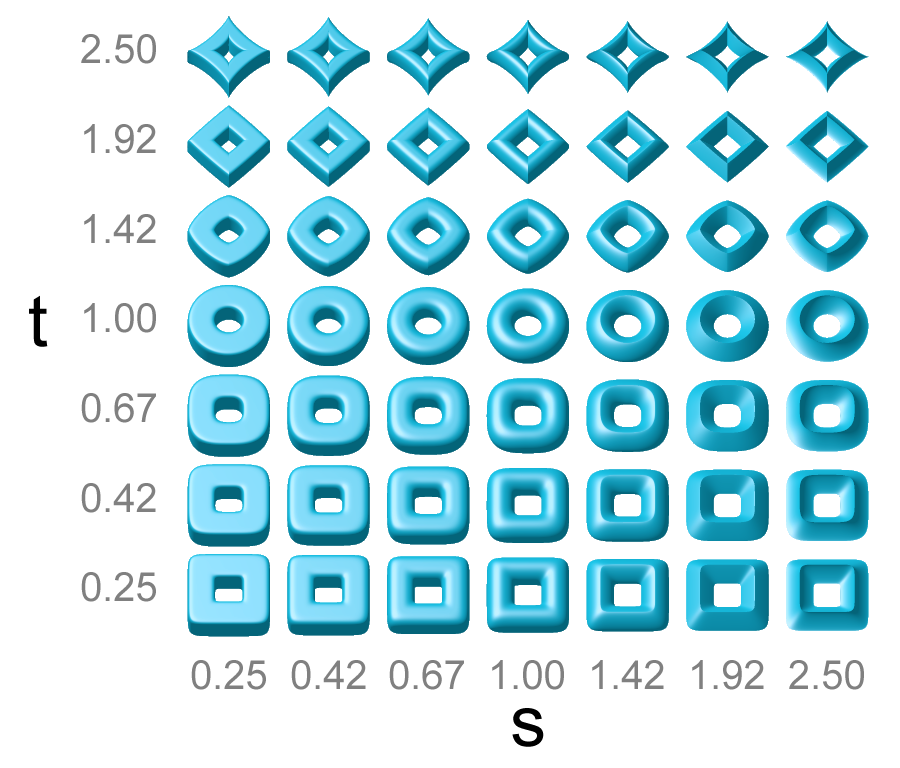
In machine learning, a Hyper basis function network, or HyperBF network, is a generalization of radial basis function (RBF) networks concept, where the Mahalanobis-like distance is used instead of the Euclidean distance measure. Hyper basis function networks were first introduced by Poggio and Girosi in the 1990 paper “Networks for Approximation and Learning”. == Network Architecture == The typical HyperBF network structure consists of a real input vector x ∈ R n {\displaystyle x\in \mathbb {R} ^{n}} , a hidden layer of activation functions and a linear output layer. The output of the network is a scalar function of the input vector, ϕ : R n → R {\displaystyle \phi :\mathbb {R} ^{n}\to \mathbb {R} } , is given by where N {\displaystyle N} is a number of neurons in the hidden layer, μ j {\displaystyle \mu _{j}} and a j {\displaystyle a_{j}} are the center and weight of neuron j {\displaystyle j} . The activation function ρ j ( | | x − μ j | | ) {\displaystyle \rho _{j}(||x-\mu _{j}||)} at the HyperBF network takes the following form where R j {\displaystyle R_{j}} is a positive definite d × d {\displaystyle d\times d} matrix. Depending on the application, the following types of matrices R j {\displaystyle R_{j}} are usually considered R j = 1 2 σ 2 I d × d {\displaystyle R_{j}={\frac {1}{2\sigma ^{2}}}\mathbb {I} _{d\times d}} , where σ > 0 {\displaystyle \sigma >0} . This case corresponds to the regular RBF network. R j = 1 2 σ j 2 I d × d {\displaystyle R_{j}={\frac {1}{2\sigma _{j}^{2}}}\mathbb {I} _{d\times d}} , where σ j > 0 {\displaystyle \sigma _{j}>0} . In this case, the basis functions are radially symmetric, but are scaled with different width. R j = d i a g ( 1 2 σ j 1 2 , . . . , 1 2 σ j z 2 ) I d × d {\displaystyle R_{j}=diag\left({\frac {1}{2\sigma _{j1}^{2}}},...,{\frac {1}{2\sigma _{jz}^{2}}}\right)\mathbb {I} _{d\times d}} , where σ j i > 0 {\displaystyle \sigma _{ji}>0} . Every neuron has an elliptic shape with a varying size. Positive definite matrix, but not diagonal. == Training == Training HyperBF networks involves estimation of weights a j {\displaystyle a_{j}} , shape and centers of neurons R j {\displaystyle R_{j}} and μ j {\displaystyle \mu _{j}} . Poggio and Girosi (1990) describe the training method with moving centers and adaptable neuron shapes. The outline of the method is provided below. Consider the quadratic loss of the network H [ ϕ ∗ ] = ∑ i = 1 N ( y i − ϕ ∗ ( x i ) ) 2 {\displaystyle H[\phi ^{}]=\sum _{i=1}^{N}(y_{i}-\phi ^{}(x_{i}))^{2}} . The following conditions must be satisfied at the optimum: where R j = W T W {\displaystyle R_{j}=W^{T}W} . Then in the gradient descent method the values of a j , μ j , W {\displaystyle a_{j},\mu _{j},W} that minimize H [ ϕ ∗ ] {\displaystyle H[\phi ^{}]} can be found as a stable fixed point of the following dynamic system: where ω {\displaystyle \omega } determines the rate of convergence. Overall, training HyperBF networks can be computationally challenging. Moreover, the high degree of freedom of HyperBF leads to overfitting and poor generalization. However, HyperBF networks have an important advantage that a small number of neurons is enough for learning complex functions.
Agent verification
Agent verification is activity to gain assurances that purposeful artificial constructs act in accordance with their specifications. While primitive forms of inorganic agents have been used in manufacturing for centuries, the study of artificial agents did not begin until the mid 20th century. Foundational work on such agents was closely bound with the emergence of artificial intelligence as an academic discipline. Early agents deployed for industrial control systems and in computing were often controlled by quite simple logic however, not involving artificial intelligence as such. When deployed as part of a multi-agent system, even such simple agents could require special agent orientated testing methods, as their collective behaviour was challenging to verify with traditional testing techniques. Difficulties in providing assurances that agents will not behave in dangerous ways became more prevalent after the introduction of LLM agents, especially after the rapid acceleration of their deployment in 2025. The verification of agent behaviour can be conducted by formal or informal methods. Informal verification requires less mathematical skill. But when agents are part of systems where errors have significant risks — such as danger to human life, environmental damage or major financial loss — formal verification is preferred. Both regulators and system designers themselves like formal verification as it provides a high degree of mathematical certainty. It is not however always possible to formally test all aspects of an agent based system's behaviour, especially where newer LLM based agents are concerned, due in part to their high degree of autonomy. Accordingly, agent verification for low impact deployments might be carried out only with informal methods, while for high impact deployments, it may be performed with a mix of formal and informal techniques. == Terminology == In academia, the term agent verification is often defined to mean activity concerned with gaining assurance that the agent behaves in accordance with its specification - whether by processes such as testing or simulation. 'Verification' is typically contrasted with 'validation', the latter meaning activity concerned with checking that the specification itself meets user or real world needs. Such definitions are not universally adhered to however - for example, in some workplaces and documents, the words 'verification' and 'validation' can be used synonymously. Efforts to gain confidence in Agents have intensified sharply since 2025 due to the rapid roll out of LLM agents; different terms are sometimes used in the commercial sector. Here the term 'agent verification' can be used in the same sense as it is in academia, but sometimes the same activity can be covered by more ambiguous and wider ranging terms such as 'Agent governance' , 'Agent observability' or 'AI agent policing'. == History == === Classical agents === The theoretical underpinnings for artificial (inorganic) agents emerged in the mid 20th century, with establishment of cybernetics and artificial intelligence. Oliver Selfridge's 1958 Pandemonium - A Paradigm for Learning paper was an important early theoretical contribution in establishing agent oriented architecture. Practical implementations of agents for real world applications began to become widespread in the 1990s, after the introduction of the belief–desire–intention software model (BDI), and agent-oriented programming. Pure digital agents were deployed in computer infrastructure for purposes such as monitoring, while agents connected to real-world sensors and actuators were increasingly used in industrial control systems. While the concept of artificial agents was interwoven with early artificial intelligence studies right from the start, early agents lacked general purpose reasoning capabilities, often only having simple if then logic. Even a device as simple as a thermostat, which has a sensor and a means of acting, can be considered a proto agent in this sense. Verifying the behaviours of a simple single agent system is not generally especially difficult, but it can be a different matter when several simple agents coexist in the same system. Craig Reynolds's work on boids showed that relatively complex, "intelligent" behaviour can emerge from a number of such simple agents working together in a Multi-agent system (MAS). By the 1990s, even the behaviour of a single agent system could sometimes be quite complex; in accordance with the Belief–desire–intention software model, agents could have believes that might evolve over time. Agents were increasingly introduced that were controlled by quite large decision tree models, which had new vulnerabilities to adversarial attack. It was becoming increasingly apparent that traditional software verification methods had limitations for testing such agents, or even for the more primitive type of agents when they were deployed as part of a MAS. It was the use of agents for industrial control systems, sometimes associated with robotics, that lent urgency to the practice of agent verification. Informal testing might be acceptable for digital agents used say to monitor whether each of an organisation's computers are properly licensed. But with an increasing potential for faulty agents to result in a failure that might cause a large fire to break out at a chemical manufacturing plant, a botched medical operation, or even a crashed aircraft, the need to develop reliable means of verifying behaviour of such agents was considered urgent. The Foundation for Intelligent Physical Agents was established in 1996. From the late 90s, a growing number of industry and university based scientists began working on the problem, with researchers publishing papers on the verification of both single and multi agent systems. Much of this work showed how formal verification techniques like model checking could be used to gain a high level of assurance that agent based systems would conform with their specification. A 2018 systematic review covering 231 studies found that model checking was the most common technique for agent verification, with theorem proving the second most commonly used formal verification method. In the first two decades of the 20th century, agents run by AI became more common, with Siri and Alexa being well known examples. But such agents still lacked general reasoning capabilities and did not pose new pressing problems for agent verification. === General purpose reasoning agents === The advent of LLMs created huge potential for further use of artificial agents, as agents based on them could have general purpose cognitive abilities. Agents run by LLMs (and occasionally non-LLM foundation models) have similar vulnerability to adversarial attack as those run by decision tree models. The wider scope of actions for LLM agents has created new challenges for their verification, over and above those present for classical agents. For example, the LLM's neural network endows it with infinite domains, an especial challenge for traditional formal verification techniques. Academics began to study the problems involved in verifying LLM agents from 2018. Deployment of such agents began to accelerate in late 2023 after OpenAI's "function-calling" API was made available, and especially after Anthropic's late 2024 introduction of Model Context Protocol (MCP), a standardised way for LLM agents to gain contextual awareness, and to act on the world by calling various external tools. The rapid rollout of LLM agents following MCP's release has seen the task of agent verification receive increased attention within academia, and also from the private sector. In 2024 and 2025 several startups focusing on LLM agent verification have been founded in both Europe and the US to meet growing demand. == Approaches == === Formal verification === Formal verification involves proving the correctness of some or all aspects of a system using mathematical methods. Such methods can range from manual formal proof, to verification assisted with automated theorem provers like Isabelle. For agent verification, model checking is by far the most frequently used formal verification method; for pre-LLM models it was often complemented with techniques using computation tree logic. Another common method is theorem proving. Formal verification provides a higher degree of confidence than informal methods, but it is not always used, even when it is possible. Sometimes a person or organisation developing software agents won't have the necessary skills, or may not see it as worth the effort if the agent(s) will not have the ability to cause much harm even if they malfunction. When agents are deployed in systems where errors could have serious consequences, the ability of formal verification methods to provide mathematical certainty tends to be strongly preferred by both regulators and designers themselves. But even for high impact systems, formal verificatio
Light scanning photomacrography
Light Scanning Photomacrography (LSP), also known as Scanning Light Photomacrography (SLP) or Deep-Field Photomacrography, is a photographic film technique that allows for high magnification light imaging with exceptional depth of field (DOF). This method overcomes the limitations of conventional macro photography, which typically only keeps a portion of the subject in acceptable focus at high magnifications. == Historical background == The principles of LSP were first documented in the early 1960s by Dan McLachlan Jr., who highlighted its capability for extreme focal depth in microscopy and in 1968 patented the process. The technique was revived and further developed in the 1980s by photographers such as Darwin Dale and Nile Root, a faculty member at the Rochester Institute of Technology. In the early 1990s, William Sharp and Charles Kazilek, both researchers at Arizona State University, also published articles describing their technique and system setup for capturing SLP images. == Predecessor to stack image photography == Light Scanning Photomacrography offered a powerful analog tool for high-detail imaging in the age of film photography. It provided a comprehensive depth of field, making it invaluable in scientific and biomedical photography. As technology and techniques continue to evolve, LSP has been replaced by digital image focus stacking. This technique uses a collection of images captured in series at different focal depths, which are then processed using computer software to create a single image with a greater focus depth than any single image. == LSP technique and results == LSP involves the use of a thin plane of light that scans across the subject, which is mounted on a stage moving perpendicular to the film plane. The technique utilizes traditional optics and is governed by the physical laws of depth of field. By moving the subject through a narrow band of illumination, the entire subject can be recorded in sharp focus from the nearest details to the farthest ones. This analog process produces sharp and detailed images by slowly recording the image on film as the specimen passes through the sheet of light that is thinner than the effective DOF. Because the image is captured at the same relative distance from the camera lens, the resulting images are axonometric rather than perspective projection, which is what the human eye sees and is typically captured by a film camera. Because all parts of an LSP image are captured at the same distance from the lens, relative measurements can be taken from an LSP photograph and can be used for comparison. == Equipment and setup == A typical LSP setup includes: A stage that can move the subject perpendicular to the film plane. Light sources, in some cases modified projectors, are used to project a thin plane of light. A camera mounted on a stable stand such as a tabletop copy stand. In 1991, Sharp and Kazilek described their SLP system that used three Kodak Ektagraphic slide projectors with zoom lenses to create a thin plane of light. The projectors each had a slide mount with two razor blades placed edge-to-edge to create a thin slit for the light to pass through. The image was captured using a Nikon FE-2 SLR camera mounted above the specimen. Kodachrome 25 slide film was used to record the image and to minimize film grain size and maximize image sharpness == Commercial systems == A commercial SLP instrument was produced by the Irvine Optical Corp. Their DYNAPHOT system was based on a photomacroscope and could capture images on 4x5 film. The instrument came with two or three illumination sources and a motorized specimen stage. The system advertised a 2X – 40X magnification range and the ability to capture images in black and white and color. Other systems have been developed by Nile Root and Theodore Clarke and reported higher magnification (up to 100X). == LSP process == Alignment and Focusing: The light sources are aligned and focused to project a thin, consistent plane of light across the subject. Stage Movement: The subject stage moves at a controlled speed, scanning through the plane of light. Image Capture: The camera shutter is set to a long exposure or can be opened and closed manually. As the subject moves through the illuminated plane, it is recorded on the film. This process is very much like painting an image onto the film using photons instead of paint. == Applications == LSP was particularly useful in biomedical photography, where it was used to document magnified subjects with increased depth of field over traditional macro and micro photography. It has been employed to capture detailed images of biological specimens, such as imaging small insects and their parts. SLP has been used to document shell collections for scientific documentation and research. Other applications include forensic science, mineralogy, and the imaging of fractured surfaces and parts == Advantages and challenges of LSP imaging == === Advantages === Exceptional depth of field: Subjects are rendered in sharp focus throughout. High magnification: Detailed images at significant magnification without sacrificing DOF. Analog precision: Provides a non-digital solution with accurate image representation. Versatility: Can be used for a range of subject sizes, from macro to non-macro scales. === Challenges === Technical complexity: Requires precise setup and alignment. Exposure time: Typically requires long exposure times due to the scanning process. Contrast control: The highly directional lighting can create harsh shadows and high contrast, which may need to be managed. Digital competition: Focus stacking has largely replaced LSP in the digital era due to convenience and flexibility. == DIY contributions == Enthusiasts and researchers have contributed to the development and accessibility of LSP by creating and sharing DIY guides. These contributions have enabled others to build their own LSP systems using readily available materials and components. Nile Root's publications provide detailed instructions and recommendations for constructing an LSP setup. These DIY systems have allowed a wider audience to explore and utilize the benefits of LSP imaging in various fields.
Imaging
Imaging is the process of creating visual representations of objects, scenes, or phenomena. The term encompasses both the formation of images through physical processes and the technologies used to capture, store, process, and display them. While traditional imaging relies on visible light, modern imaging systems can visualize information across the electromagnetic spectrum and through other physical phenomena such as sound waves, magnetic fields, and particle emissions, enabling the visualization of subjects invisible to the human eye. Imaging science is the multidisciplinary field concerned with the theoretical foundations and practical applications of image creation and analysis. The field draws on physics, mathematics, electrical engineering, computer science, computer vision, and perceptual psychology to develop systems that generate, collect, duplicate, analyze, modify, and visualize images. == Principles == === The imaging chain === The imaging chain is a conceptual framework describing the interconnected components of any imaging system. Understanding each link in this chain allows engineers and scientists to optimize system performance for specific applications. The chain begins with the subject and its observable properties, typically energy that is emitted, reflected, or transmitted. A light source or other energy source may illuminate the subject to make these properties detectable. The capture device then collects this energy using appropriate sensors: optical systems for electromagnetic radiation, transducers for acoustic waves, or antenna arrays for radio frequencies. In digital systems, a processor converts the captured signals into a format suitable for rendering, applying algorithms for noise reduction, enhancement, or reconstruction. Finally, a display renders the processed information as a visible image on media such as paper, screens, or projection surfaces. Throughout this process, the characteristics of the human visual system inform design decisions, as the ultimate purpose of most imaging systems is to convey information to human observers. === Coherent and non-coherent imaging === Imaging systems are often classified by whether they use coherent or non-coherent illumination. Coherent imaging employs an active source that produces waves with a consistent phase relationship, as in radar, synthetic aperture radar, medical ultrasound, and optical coherence tomography. These systems can capture phase information in addition to amplitude, enabling techniques such as holography and interferometry. Non-coherent imaging systems, including conventional photography, fluorescence microscopy, and telescopes, rely on illumination sources where light waves have random phase relationships. == Methods and applications == Imaging methods span a wide range of physical principles, each suited to particular applications. Optical imaging encompasses photography, cinematography, microscopy, and telescopic observation. These methods capture electromagnetic radiation in or near the visible spectrum and form the basis of most consumer and scientific imaging. Extensions include thermography, which visualizes infrared radiation to reveal temperature distributions, and multispectral imaging, which captures data across multiple wavelength bands for applications in remote sensing and materials analysis. Medical imaging comprises techniques designed to visualize the interior of the human body for diagnostic and therapeutic purposes. Radiography and computed tomography use X-rays to image dense structures such as bone. Magnetic resonance imaging exploits nuclear magnetic properties to produce detailed soft-tissue images without ionizing radiation. Ultrasound imaging uses high-frequency sound waves and is particularly valuable for real-time imaging and fetal monitoring. Nuclear medicine techniques such as positron emission tomography track radioactive tracers to reveal metabolic activity. Emerging modalities include photoacoustic imaging, which combines optical and acoustic principles, and Magneto-acousto-electrical tomography, which maps electrical conductivity in biological tissues. Acoustic imaging uses sound waves to create images. Beyond medical ultrasound, applications include sonar for underwater navigation and mapping, seismic imaging for geological exploration, and industrial non-destructive testing. Radar and microwave imaging employ radio waves to detect and image objects. Synthetic aperture radar produces high-resolution images from aircraft or satellites regardless of weather or lighting conditions, making it essential for Earth observation and reconnaissance. Ground-penetrating radar images subsurface structures for archaeological and engineering applications. Electron and particle imaging use beams of electrons or other particles to achieve resolutions far beyond the diffraction limit of visible light. Electron microscopes can image individual atoms, enabling advances in materials science and structural biology. Chemical imaging combines spectroscopy with spatial imaging to map the chemical composition of samples, with applications in pharmaceutical development, food safety, and forensics. LIDAR (Light Detection and Ranging) measures distances using laser pulses to create three-dimensional representations of surfaces and objects, widely used in autonomous vehicles, topographic mapping, and forestry. Computational and digital imaging encompasses image processing, computer graphics, three-dimensional rendering, and digital image restoration. Computer vision applies algorithmic analysis to extract information from images automatically. == History == Photography and imaging have always been intertwined. When Joseph Nicéphore Niépce created the first permanent photograph using heliography in 1826, and Louis Daguerre refined the process into the daguerreotype a decade later, they weren't just inventing a new art form, they were laying the groundwork for an entire scientific discipline built on silver halide chemistry. For most of the nineteenth century, photography remained the province of specialists. That changed with George Eastman's Kodak camera, introduced in 1888 with the slogan "You press the button, we do the rest." Suddenly, anyone could take pictures. Around the same time, Wilhelm Röntgen stumbled onto X-rays in 1895, an accident that would spawn the entire field of medical imaging. World War II proved to be a turning point. Radar technology, developed frantically on both sides of the conflict, introduced concepts that engineers would later adapt for synthetic aperture radar and medical ultrasound. Then the charge-coupled device came: Willard Boyle and George E. Smith built the first one at Bell Labs in 1969, and within a few decades it had made film nearly obsolete. Magnetic resonance imaging arrived in the 1970s, offering doctors something X-rays never could, detailed views of soft tissue without any radiation. Digital cameras took over fast. By the 2000s, film was already in decline; by the 2010s, smartphones had put a surprisingly capable camera in nearly every pocket. Features that once required real skill, proper exposure, sharp focus, accurate color, became automatic. Today, billions of photos get uploaded to social media every day. As a result, a growing issue is that generative artificial intelligence can fabricate photorealistic images from scratch. What counts as a "real" photograph is no longer necessarily obvious.
Evolutionary robotics
Evolutionary robotics is an embodied approach to Artificial Intelligence (AI) in which robots are automatically designed using Darwinian principles of natural selection. The design of a robot, or a subsystem of a robot such as a neural controller, is optimized against a behavioral goal (e.g. run as fast as possible). Usually, designs are evaluated in simulations as fabricating thousands or millions of designs and testing them in the real world is prohibitively expensive in terms of time, money, and safety. An evolutionary robotics experiment starts with a population of randomly generated robot designs. The worst performing designs are discarded and replaced with mutations and/or combinations of the better designs. This evolutionary algorithm continues until a prespecified amount of time elapses or some target performance metric is surpassed. Evolutionary robotics methods are particularly useful for engineering machines that must operate in environments in which humans have limited intuition (nanoscale, space, etc.). Evolved simulated robots can also be used as scientific tools to generate new hypotheses in biology and cognitive science, and to test old hypothesis that require experiments that have proven difficult or impossible to carry out in reality. == History == In the early 1990s, two separate European groups demonstrated different approaches to the evolution of robot control systems. Dario Floreano and Francesco Mondada at EPFL evolved controllers for the Khepera robot. Adrian Thompson, Nick Jakobi, Dave Cliff, Inman Harvey, and Phil Husbands evolved controllers for a Gantry robot at the University of Sussex. However the body of these robots was presupposed before evolution. The first simulations of evolved robots were reported by Karl Sims and Jeffrey Ventrella of the MIT Media Lab, also in the early 1990s. However these so-called virtual creatures never left their simulated worlds. The first evolved robots to be built in reality were 3D-printed by Hod Lipson and Jordan Pollack at Brandeis University at the turn of the 21st century.
Template matching
Template matching is a technique in digital image processing for finding small parts of an image which match a template image. It can be used for quality control in manufacturing, navigation of mobile robots, or edge detection in images. The main challenges in a template matching task are detection of occlusion, when a sought-after object is partly hidden in an image; detection of non-rigid transformations, when an object is distorted or imaged from different angles; sensitivity to illumination and background changes; background clutter; and scale changes. == Feature-based approach == The feature-based approach to template matching relies on the extraction of image features, such as shapes, textures, and colors, that match the target image or frame. This approach is usually achieved using neural networks and deep-learning classifiers such as VGG, AlexNet, and ResNet.Convolutional neural networks (CNNs), which many modern classifiers are based on, process an image by passing it through different hidden layers, producing a vector at each layer with classification information about the image. These vectors are extracted from the network and used as the features of the image. Feature extraction using deep neural networks, like CNNs, has proven extremely effective has become the standard in state-of-the-art template matching algorithms. This feature-based approach is often more robust than the template-based approach described below. As such, it has become the state-of-the-art method for template matching, as it can match templates with non-rigid and out-of-plane transformations, as well as high background clutter and illumination changes. == Template-based approach == For templates without strong features, or for when the bulk of a template image constitutes the matching image as a whole, a template-based approach may be effective. Since template-based matching may require sampling of a large number of data points, it is often desirable to reduce the number of sampling points by reducing the resolution of search and template images by the same factor before performing the operation on the resultant downsized images. This pre-processing method creates a multi-scale, or pyramid, representation of images, providing a reduced search window of data points within a search image so that the template does not have to be compared with every viable data point. Pyramid representations are a method of dimensionality reduction, a common aim of machine learning on data sets that suffer the curse of dimensionality. == Common challenges == In instances where the template may not provide a direct match, it may be useful to implement eigenspaces to create templates that detail the matching object under a number of different conditions, such as varying perspectives, illuminations, color contrasts, or object poses. For example, if an algorithm is looking for a face, its template eigenspaces may consist of images (i.e., templates) of faces in different positions to the camera, in different lighting conditions, or with different expressions (i.e., poses). It is also possible for a matching image to be obscured or occluded by an object. In these cases, it is unreasonable to provide a multitude of templates to cover each possible occlusion. For example, the search object may be a playing card, and in some of the search images, the card is obscured by the fingers of someone holding the card, or by another card on top of it, or by some other object in front of the camera. In cases where the object is malleable or poseable, motion becomes an additional problem, and problems involving both motion and occlusion become ambiguous. In these cases, one possible solution is to divide the template image into multiple sub-images and perform matching on each subdivision. == Deformable templates in computational anatomy == Template matching is a central tool in computational anatomy (CA). In this field, a deformable template model is used to model the space of human anatomies and their orbits under the group of diffeomorphisms, functions which smoothly deform an object. Template matching arises as an approach to finding the unknown diffeomorphism that acts on a template image to match the target image. Template matching algorithms in CA have come to be called large deformation diffeomorphic metric mappings (LDDMMs). Currently, there are LDDMM template matching algorithms for matching anatomical landmark points, curves, surfaces, volumes. == Template-based matching explained using cross correlation or sum of absolute differences == A basic method of template matching sometimes called "Linear Spatial Filtering" uses an image patch (i.e., the "template image" or "filter mask") tailored to a specific feature of search images to detect. This technique can be easily performed on grey images or edge images, where the additional variable of color is either not present or not relevant. Cross correlation techniques compare the similarities of the search and template images. Their outputs should be highest at places where the image structure matches the template structure, i.e., where large search image values get multiplied by large template image values. This method is normally implemented by first picking out a part of a search image to use as a template. Let S ( x , y ) {\displaystyle S(x,y)} represent the value of a search image pixel, where ( x , y ) {\displaystyle (x,y)} represents the coordinates of the pixel in the search image. For simplicity, assume pixel values are scalar, as in a greyscale image. Similarly, let T ( x t , y t ) {\textstyle T(x_{t},y_{t})} represent the value of a template pixel, where ( x t , y t ) {\textstyle (x_{t},y_{t})} represents the coordinates of the pixel in the template image. To apply the filter, simply move the center (or origin) of the template image over each point in the search image and calculate the sum of products, similar to a dot product, between the pixel values in the search and template images over the whole area spanned by the template. More formally, if ( 0 , 0 ) {\displaystyle (0,0)} is the center (or origin) of the template image, then the cross correlation T ⋆ S {\displaystyle T\star S} at each point ( x , y ) {\displaystyle (x,y)} in the search image can be computed as: ( T ⋆ S ) ( x , y ) = ∑ ( x t , y t ) ∈ T T ( x t , y t ) ⋅ S ( x t + x , y t + y ) {\displaystyle (T\star S)(x,y)=\sum _{(x_{t},y_{t})\in T}T(x_{t},y_{t})\cdot S(x_{t}+x,y_{t}+y)} For convenience, T {\displaystyle T} denotes both the pixel values of the template image as well as its domain, the bounds of the template. Note that all possible positions of the template with respect to the search image are considered. Since cross correlation values are greatest when the values of the search and template pixels align, the best matching position ( x m , y m ) {\displaystyle (x_{m},y_{m})} corresponds to the maximum value of T ⋆ S {\displaystyle T\star S} over S {\displaystyle S} . Another way to handle translation problems on images using template matching is to compare the intensities of the pixels, using the sum of absolute differences (SAD) measure. To formulate this, let I S ( x s , y s ) {\displaystyle I_{S}(x_{s},y_{s})} and I T ( x t , y t ) {\displaystyle I_{T}(x_{t},y_{t})} denote the light intensity of pixels in the search and template images with coordinates ( x s , y s ) {\displaystyle (x_{s},y_{s})} and ( x t , y t ) {\displaystyle (x_{t},y_{t})} , respectively. Then by moving the center (or origin) of the template to a point ( x , y ) {\displaystyle (x,y)} in the search image, as before, the sum of absolute differences between the template and search pixel intensities at that point is: S A D ( x , y ) = ∑ ( x t , y t ) ∈ T | I T ( x t , y t ) − I S ( x t + x , y t + y ) | {\displaystyle SAD(x,y)=\sum _{(x_{t},y_{t})\in T}\left\vert I_{T}(x_{t},y_{t})-I_{S}(x_{t}+x,y_{t}+y)\right\vert } With this measure, the lowest SAD gives the best position for the template, rather than the greatest as with cross correlation. SAD tends to be relatively simple to implement and understand, but it also tends to be relatively slow to execute. A simple C++ implementation of SAD template matching is given below. == Implementation == In this simple implementation, it is assumed that the above described method is applied on grey images: This is why Grey is used as pixel intensity. The final position in this implementation gives the top left location for where the template image best matches the search image. One way to perform template matching on color images is to decompose the pixels into their color components and measure the quality of match between the color template and search image using the sum of the SAD computed for each color separately. == Speeding up the process == In the past, this type of spatial filtering was normally only used in dedicated hardware solutions because of the computational complexity of the operation, however we can lessen this complexity b
ActivTrak
ActivTrak is an American company that produces workforce analytics and productivity software. The company was founded in 2009 by Birch Grove Software and is headquartered in Austin, Texas. The company has raised US$77.5 million in funding and is backed by Sapphire Ventures and Elsewhere Partners. == History == ActivTrak was founded in 2009 by Herb Axilrod and Anton Seidler in Dallas, Texas. ActivTrak's first on-demand software product launched in 2012, and the workforce analytics platform launched in 2015. It uses data sourced from more than 9,500 customers and 900,000 users. In 2019, ActivTrak raised $20 million in a Series A round of funding with Elsewhere Partners, a growth-stage venture capital firm that principally invests in B2B startups. Rita Selvaggi assumed the role of CEO. In 2020, ActivTrak raised $50M in a Series B round of funding with Sapphire Ventures and Elsewhere Partners. The company also introduced the ActivTrak Productivity Lab, an online resource about workforce productivity research, industry benchmark data, and best practices. == Product == ActivTrak is a workforce analytics and productivity platform that uses reports, dashboards, and data analysis. The platform uses machine learning (AI) to collect and analyze user activity data and produce reports about workforce productivity. The software runs on Microsoft Windows, Mac, Chrome, Terminal Services, and VDI. It includes the ActivTrak Agent, which runs in the background and collects data. It responds to user activity, sensing mouse and keyboard movement in the active window(s) of the user's device. This data is collected and stored in a database that aggregates the data based on the user's request. ActivTrak does not utilize keystroke logging, content scraping, camera access, video recording or mobile device monitoring. The database leverages data analytics to generate account and team benchmarks, and identify productivity patterns and outliers. == Awards == Built In, 100 Best Midsize Places to Work in Austin, 2025 G2, Winter: Best Estimated ROI, High Performer, Best Relationship, Best Support, Users Most Likely to Recommend, Easiest Setup, Easiest Admin, Best Meets Requirements, Users Love Us, 2025 TrustRadius, Buyer’s Choice, 2025 Deloitte Technology Fast 500, No. 468 Fastest-Growing Company, 2024 Product Marketing Alliance, AI Marketing Innovation, 2024 Fortune Best Workplaces in Technology™, 2024 Inc. 5000, No. 2335 of America’s Fastest-Growing Private Companies, 2024 Fortune Best Workplaces in Texas™, 2024 Reworked IMPACT Gold Award: Most Innovative Workplace Productivity Solution, 2024 TrustRadius, Most Loved, 2024 Great Place To Work-Certified™, 2024 Inc. 5000 Regionals: Southwest, 2024 Brandon Hall Group, Best Advance in HR Predictive Analytics Technology, 2024