The impact of artificial intelligence on workers includes both applications to improve worker safety and health, and potential hazards that must be controlled. One potential application is using AI to eliminate hazards by removing humans from hazardous situations that involve risk of stress, overwork, or musculoskeletal injuries. Predictive analytics may also be used to identify conditions that may lead to hazards such as fatigue, repetitive strain injuries, or toxic substance exposure, leading to earlier interventions. Another is to streamline workplace safety and health workflows through automating repetitive tasks, enhancing safety training programs through virtual reality, or detecting and reporting near misses. When used in the workplace, AI also presents the possibility of new hazards. These may arise from machine learning techniques leading to unpredictable behavior and inscrutability in their decision-making, or from cybersecurity and information privacy issues. Many hazards of AI are psychosocial due to its potential to cause changes in work organization. These include increased monitoring leading to micromanagement, algorithms unintentionally or intentionally mimicking undesirable human biases, and assigning blame for machine errors to the human operator instead. AI may also lead to physical hazards in the form of human–robot collisions, and ergonomic risks of control interfaces and human–machine interactions. Hazard controls include cybersecurity and information privacy measures, communication and transparency with workers about data usage, and limitations on collaborative robots. From a workplace safety and health perspective, only "weak" or "narrow" AI that is tailored to a specific task is relevant, as there are many examples that are currently in use or expected to come into use in the near future. Certain digital technologies are predicted to result in job losses. Starting in the 2020s, the adoption of modern robotics has led to net employment growth. However, many businesses anticipate that automation, or employing robots would result in job losses in the future. This is especially true for companies in Central and Eastern Europe. Other digital technologies, such as platforms or big data, are projected to have a more neutral impact on employment. A large number of tech workers have been laid off starting in 2023; many such job cuts have been attributed to artificial intelligence. == Health and safety applications == In order for any potential AI health and safety application to be adopted, it requires acceptance by both managers and workers. For example, worker acceptance may be diminished by concerns about information privacy, or from a lack of trust and acceptance of the new technology, which may arise from inadequate transparency or training. Alternatively, managers may emphasize increases in economic productivity rather than gains in worker safety and health when implementing AI-based systems. === Eliminating hazardous tasks === AI may increase the scope of work tasks where a worker can be removed from a situation that carries risk. In a sense, while traditional automation can replace the functions of a worker's body with a robot, AI effectively replaces the functions of their brain with a computer. Hazards that can be avoided include stress, overwork, musculoskeletal injuries, and boredom. This can expand the range of affected job sectors into white-collar and service sector jobs such as in medicine, finance, and information technology. === Analytics to reduce risk === Machine learning is used for people analytics to make predictions about worker behavior to assist management decision-making, such as hiring and performance assessment. These could also be used to improve worker health. The analytics may be based on inputs such as online activities, monitoring of communications, location tracking, and voice analysis and body language analysis of filmed interviews. For example, sentiment analysis may be used to spot fatigue to prevent overwork. Decision support systems have a similar ability to be used to, for example, prevent industrial disasters or make disaster response more efficient. For manual material handling workers, predictive analytics and artificial intelligence may be used to reduce musculoskeletal injury. Traditional guidelines are based on statistical averages and are geared towards anthropometrically typical humans. The analysis of large amounts of data from wearable sensors may allow real-time, personalized calculation of ergonomic risk and fatigue management, as well as better analysis of the risk associated with specific job roles. Wearable sensors may also enable earlier intervention against exposure to toxic substances than is possible with area or breathing zone testing on a periodic basis. Furthermore, the large data sets generated could improve workplace health surveillance, risk assessment, and research. === Streamlining safety and health workflows === AI has also been used to attempt to make the workplace safety and health workflow more efficient. One example is coding of workers' compensation claims, which are submitted in a prose narrative form and must manually be assigned standardized codes. AI is being investigated to perform this task faster, more cheaply, and with fewer errors. == Hazards == There are several broad aspects of AI that may give rise to specific hazards. The risks depend on implementation rather than the mere presence of AI. Systems using sub-symbolic AI such as machine learning may behave unpredictably and are more prone to inscrutability in their decision-making. This is especially true if a situation is encountered that was not part of the AI's training dataset, and is exacerbated in environments that are less structured. Undesired behavior may also arise from flaws in the system's perception (arising either from within the software or from sensor degradation), knowledge representation and reasoning, or from software bugs. They may arise from improper training, such as a user applying the same algorithm to two problems that do not have the same requirements. Machine learning applied during the design phase may have different implications than that applied at runtime. Systems using symbolic AI are less prone to unpredictable behavior. The use of AI also increases cybersecurity risks relative to platforms that do not use AI, and information privacy concerns about collected data may pose a hazard to workers. === Psychosocial === Psychosocial hazards are those that arise from the way work is designed, organized, and managed, or its economic and social contexts, rather than arising from a physical substance or object. They cause not only psychiatric and psychological outcomes such as occupational burnout, anxiety disorders, and depression, but they can also cause physical injury or illness such as cardiovascular disease or musculoskeletal injury. Many hazards of AI are psychosocial in nature due to its potential to cause changes in work organization, in terms of increasing complexity and interaction between different organizational factors. However, psychosocial risks are often overlooked by designers of advanced manufacturing systems. Einola and Khoreva explore how different organizational groups perceive and interact with AI technologies. Their research shows that successful AI integration depends on human ownership and contextual understanding. They caution against blind technological optimism and stress the importance of tailoring AI use to specific workplace ecosystems. This perspective reinforces the need for inclusive design and transparent implementation strategies. ==== Changes in work practices ==== Over-reliance on AI tools may lead to deskilling of some professions. When AI becomes a substitute for traditional peer collaboration and mentorship, there is a risk of diminishing opportunities for interpersonal skill development and team-based learning. Increased monitoring may lead to micromanagement and thus to stress and anxiety. A perception of surveillance may also lead to stress. Controls for these include consultation with worker groups, extensive testing, and attention to introduced bias. Wearable sensors, activity trackers, and augmented reality may also lead to stress from micromanagement, both for assembly line workers and gig workers. Gig workers also lack the legal protections and rights of formal workers. Newell & Marabelli argue that AI alters power dynamics and employee autonomy, requiring a more nuanced understanding of its social and organizational implications. There is also the risk of people being forced to work at a robot's pace, or to monitor robot performance at nonstandard hours. A 2025 preprint paper based on users' interactions with the AI chatbot Microsoft Copilot identified forty jobs that the author's claimed had high overlaps with the capabilities of AI. Some media outlets used this paper to report on jobs becoming obsolete. Cri
Shape factor (image analysis and microscopy)
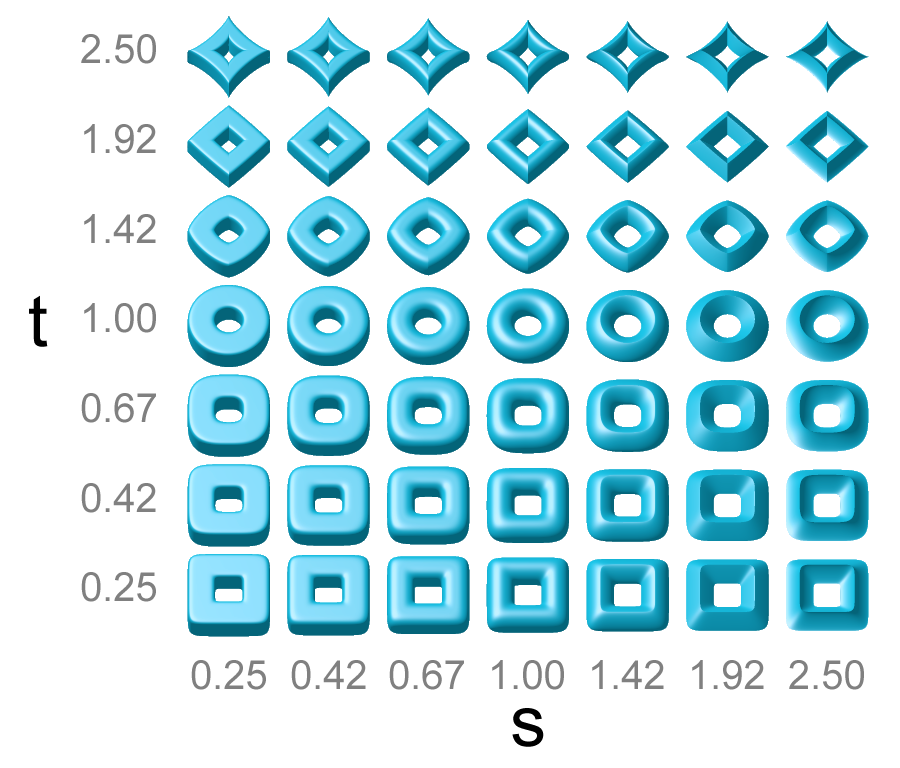
Shape factors are dimensionless quantities used in image analysis and microscopy that numerically describe the shape of a particle, independent of its size. Shape factors are calculated from measured dimensions, such as diameter, chord lengths, area, perimeter, centroid, moments, etc. The dimensions of the particles are usually measured from two-dimensional cross-sections or projections, as in a microscope field, but shape factors also apply to three-dimensional objects. The particles could be the grains in a metallurgical or ceramic microstructure, or the microorganisms in a culture, for example. The dimensionless quantities often represent the degree of deviation from an ideal shape, such as a circle, sphere or equilateral polyhedron. Shape factors are often normalized, that is, the value ranges from zero to one. A shape factor equal to one usually represents an ideal case or maximum symmetry, such as a circle, sphere, square or cube. == Aspect ratio == The most common shape factor is the aspect ratio, a function of the largest diameter and the smallest diameter orthogonal to it: A R = d min d max {\displaystyle A_{R}={\frac {d_{\min }}{d_{\max }}}} The normalized aspect ratio varies from approaching zero for a very elongated particle, such as a grain in a cold-worked metal, to near unity for an equiaxed grain. The reciprocal of the right side of the above equation is also used, such that the AR varies from one to approaching infinity. == Circularity == Another very common shape factor is the circularity (or isoperimetric quotient), a function of the perimeter P and the area A: f circ = 4 π A P 2 {\displaystyle f_{\text{circ}}={\frac {4\pi A}{P^{2}}}} The circularity of a circle is 1, and much less than one for a starfish footprint. The reciprocal of the circularity equation is also used, such that fcirc varies from one for a circle to infinity. == Elongation shape factor == The less-common elongation shape factor is defined as the square root of the ratio of the two second moments in of the particle around its principal axes. f elong = i 2 i 1 {\displaystyle f_{\text{elong}}={\sqrt {\frac {i_{2}}{i_{1}}}}} == Compactness shape factor == The compactness shape factor is a function of the polar second moment in of a particle and a circle of equal area A. f comp = A 2 2 π i 1 2 + i 2 2 {\displaystyle f_{\text{comp}}={\frac {A^{2}}{2\pi {\sqrt {{i_{1}}^{2}+{i_{2}}^{2}}}}}} The fcomp of a circle is one, and much less than one for the cross-section of an I-beam. == Waviness shape factor == The waviness shape factor of the perimeter is a function of the convex portion Pcvx of the perimeter to the total. f wav = P cvx P {\displaystyle f_{\text{wav}}={\frac {P_{\text{cvx}}}{P}}} Some properties of metals and ceramics, such as fracture toughness, have been linked to grain shapes. == An application of shape factors == Greenland, the largest island in the world, has an area of 2,166,086 km2; a coastline (perimeter) of 39,330 km; a north–south length of 2670 km; and an east–west length of 1290 km. The aspect ratio of Greenland is A R = 1290 2670 = 0.483 {\displaystyle A_{R}={\frac {1290}{2670}}=0.483} The circularity of Greenland is f circ = 4 π ( 2166086 ) 39330 2 = 0.0176. {\displaystyle f_{\text{circ}}={\frac {4\pi (2166086)}{39330^{2}}}=0.0176.} The aspect ratio is agreeable with an eyeball-estimate on a globe. Such an estimate on a typical flat map, using the Mercator projection, would be less accurate due to the distorted scale at high latitudes. The circularity is deceptively low, due to the fjords that give Greenland a very jagged coastline (see the coastline paradox). A low value of circularity does not necessarily indicate a lack of symmetry, and shape factors are not limited to microscopic objects.
TCEC Season 14
The 14th season of the Top Chess Engine Championship took place between 17 November 2018 and 24 February 2019. Stockfish was the defending champion, having defeated Komodo in the previous season's superfinal. The season is notable for two things: the emergence of two strong, new engines, the Komodo variant Komodo Monte Carlo tree search (MCTS) and the neural network engine Leela Chess Zero, and the dramatic superfinal. Komodo MCTS and Leela fought their way from Division 4 and Division 3 respectively to the Premier Division, with Leela further qualifying for the superfinal against Stockfish. The superfinal was a topsy-turvy affair with the lead changing hands several times. It finished as the closest superfinal TCEC has ever seen, with Stockfish winning by a single game, 50.5–49.5 (+10 =81 -9). == Overview == === Structure === The season comprised five divisions: from the lowest Division 4 to the Premier Division. The top two engines of each division promote to the division above, while the bottom two engines relegate. The top two engines of the Premier Division contest a 100-game superfinal. The lengths of the opening books used increases as the divisions progress. The superfinal itself used a custom opening book designed by Jeroen Noomen. === Rules === The TCEC draw and win rules were slightly modified for Season 14. The game is now adjudicated as drawn if, after move 30, both engines have evals ±0.08 for five consecutive moves, and there are neither pawn moves nor a capture. Win adjudication now occurs if both engines have an eval of ±10 for five consecutive moves. Following the controversy over DeusX's participation last season, the uniqueness rule for neural networks was modified such that at least two of the following three hallmarks must be unique: The code for training the neural network The neural network (and weights file) itself The engine that executes this network This change meant DeusX did not meet the uniqueness criteria and therefore did not participate. Aside from this change, the season used the standard rules of the TCEC. == Results == === Division 4 === New entrant Komodo MCTS dominated Division 4, winning by a clear four points, although it did lose a game to second-place finisher rofChade. Fellow new entrant Scorpio NN performed badly and finished last, drawing only one game and losing the rest. === Division 3 === The neural network engine Leela Chess Zero had just missed promotion to Division 2 in the previous season. Since its relatively weak performance last season was partly due to hardware problems, and since it had shown a lot of improvement in strength, it was the hot favourite in this division. Leela lived up to its billing by comprehensively defeating everyone else. In a portent of future divisions however, Leela surprisingly dropped a game to third-place Arasan. Komodo MCTS was also improving quickly, and an updated version finished second behind Leela. The gap between second and third was 6.5 points, illustrating the gulf in class. === Division 2 === Although Division 2 engines are significantly stronger than Division 3, Leela and Komodo MCTS continued to dominate the competition, and again finished first and second. Komodo MCTS only lost one game to Leela, while Leela's tendency to occasionally lose to weaker engines saw her losing a game to 4th-placed Booot. Third place finisher Xiphos gave Leela and Komodo MCTS a run for their money, and was in the running up until the final rounds when it lost a crucial game to Leela. This loss left it one point behind Komodo MCTS in the final standings. === Division 1 === Leela and Komodo MCTS's rampage through the lower divisions continued, and they again finished first and second. In a demonstration of how much it had improved, Leela scored 20/28 in this division, the same score it had achieved in Division 2. This was also a TCEC points record for this division. However, Leela dropped a game against fourth-place finisher Chiron. Komodo MCTS, which had yet to lose a game in the lower divisions except to Leela, also conceded its first loss to third-place Fizbo. At the other end of the table, former champions Jonny and Fritz, which had not been updated, found themselves outclassed and finished second-last and last respectively; however with fellow competitor Ginkgo crashing five times (and therefore being disqualified), Jonny managed to stay in the division. The penultimate game for this division set a new TCEC moves record for a decisive game: 308 moves before Leela defeated Fritz. === Premier division === This was the strongest premier division ever, with multiple-time champions Stockfish, Komodo, and Houdini in the mix. Right from the start it became clear that Stockfish was in a league of its own, and it dominated the division, scoring wins against every other engine without losing a game. Second place however was a hotly-contested affair, with Leela, Komodo and Houdini neck-and-neck for most of the division. Houdini took the early lead, but Komodo gained second after winning two games by forfeit when its sibling Komodo MCTS crashed. This led to murmurs of a "Konspiracy". However, when both Komodo and Houdini failed to score more wins against the lower half of the field, Leela was able to take the lead. Halfway through the division the race was upended again when Leela went through a bad streak, losing three games in a row to Stockfish, Komodo, and Fire. This led to Komodo regaining second place, only for Komodo MCTS to crash yet again. By TCEC rules this meant Komodo MCTS was disqualified and all its scores were zeroed out, which put Leela back in second place. With three games left, Leela missed a win against Andscacs, which would've more or less secured her a place in the superfinal. Meanwhile, Komodo kept the division interesting by winning two of its last three games. Because Komodo had superior tiebreakers to Leela, this meant Komodo would qualify for the superfinal unless Leela managed to hold Stockfish to a draw with Black in the last game of the division. In a tense final game, Stockfish came close to winning, but missed the winning line. Leela managed to draw and qualified for the superfinal. At the other end of the table, it was quickly apparent that Ethereal and Andscacs were the weakest engines and would likely relegate. However, when Komodo MCTS was disqualified (and therefore relegated), it threw both engines a lifeline, since they could now stay in the division by beating the other. Andscacs was able to score a head-to-head win against Ethereal, but was crushed by Stockfish (+0 =2 -4) and Leela (+0 =3 -3). Ethereal didn't manage to score a win in the entire division, but did manage to score more draws than Andscacs, condemning Andscacs to relegation. === Superfinal === Going into the superfinal expectations were high for Leela: she had received a new network and had just won her first major competition when she defeated Houdini in the second TCEC cup. However, she had won the tournament without having played Stockfish (who had been surprisingly eliminated by Houdini in the semifinals). That, plus the fact that Stockfish dominated Premier Division and had never lost a match to Leela, left it unclear which engine was superior, although most spectators favored Stockfish. The superfinal turned out to be a roller-coaster. It began with Stockfish drawing first blood in game 7, and then scoring another win in game 10. Leela hit back with wins in game 11 and 13, but then lost games 20, 21, and 22. This gave Stockfish a 3-point lead. However, in the next 30 games, Leela was the only one to score wins: it first equalized by winning games 25, 27, and 29, and then took the lead by winning games 49 and 53. Stockfish won game 56, but Leela won game 63, maintaining her lead. There followed two dramatic games. In game 65, Leela built up a winning position. Stockfish showed a +153 evaluation, indicating that it had found a forced line leading to an endgame tablebase win; indeed analysis with 7-piece tablebases showed that Leela's position was winning. Under previous seasons' rules, the game would have been adjudicated as a win because Leela's evaluation was above 6.5. However under the new rules, Leela's +8.92 evaluation was not enough to adjudicate. It turned out that Leela could not see the winning line, and shuffled her pieces aimlessly, leading to a 50-move draw. In game 66, Stockfish was given a substantial advantage by the opening, but failed to make the most of it. The evaluations were leveling out to zero when the internet connection to the GPU servers was cut off. By tournament rules, this meant the game was replayed from scratch. After a further internet disconnection and restart, Stockfish handled the opening better and won, leaving Leela with a 1-point lead. In the last third of the superfinal, there followed more drama as Leela often built up strong advantages, but Stockfish showed great resourcefulness in defending inferior positions. Meanwh
The Murderbot Diaries
The Murderbot Diaries is a science fiction series by American author Martha Wells, published by Tor Books. The series is told from the perspective of the titular cyborg guard, a "SecUnit" owned by a futuristic megacorporation. SecUnits include "governor" modules that control and punish the constructs if they take any actions not approved by the company. The ironically self-named "Murderbot" hacked and disabled the module but pretends to be a normal SecUnit, staving off the boredom of security work by watching media. As it spends more time with a series of caring entities (both humans and artificial intelligences), it develops genuine friendships and emotional connections, which it finds inconvenient. The TV series Murderbot is based on the novels by Martha Wells. == Books == === Setting === In an advanced largely hyper-capitalist space-faring society, travel between star systems is routine due to now-stable wormhole technology. Initially, wormhole travel was unreliable, but has since improved to the point where "lost" colonies are being found. People reside on planets, some of which have been terraformed, or on space habitats which have full life support and artificial gravity. Most people who can afford it have technology that allows them to tap into ubiquitous data feeds supplying all kinds of information, including entertainment. This technology can be worn, or be implanted into the body. Sentient and semi-sentient artificial intelligences perform tasks such as operating starships, mining, controlling habitats, moving cargo, waging corporate warfare, providing physical pleasure and comfort, or security. Most of these purposes are fulfilled by "bots" of varying complexity and intelligence, but the last three are respectively performed by CombatUnits, ComfortUnits, and SecUnits. The characters and narrator of the book call these conscious entities "constructs", but they are functionally cyborgs (cybernetic organisms): part machine, part organic. A significant distinction, however, is that they are manufactured entities, not born and later modified. The Corporation Rim is a profit-oriented, cutthroat part of this society that indulges in espionage, assassination, indentured slavery, and ruthless exploitation of resources. One particular target of the corporations is illegal "alien remnant" exploitation. These remnants are often extremely dangerous to people and machines. The laws are enforced by other corporations. Outside the Corporation Rim are colonies, such as Preservation, that have established their right to exist under various laws that, at least for the time being, the corporations are unwilling to test. Wells noted in 2017 that All Systems Red, Artificial Condition, Rogue Protocol, and Exit Strategy "have an overarching story, with the fourth one bringing the arc to a conclusion". === Story chronology === "Compulsory" All Systems Red Artificial Condition Rogue Protocol Exit Strategy "Rapport" "Home" Fugitive Telemetry Network Effect System Collapse Platform Decay === All Systems Red (2017) === A scientific expedition on an alien planet goes awry when one of its members is attacked by a giant native creature. She is saved by the expedition's SecUnit (Security Unit), a security construct with a mixture of robot and human features. The SecUnit has secretly hacked the governor module allowing it to be controlled by humans and has named itself Murderbot, as it is heavily armed and designed for combat. However, it prefers to spend its time watching space operas and is uncomfortable interacting with humans. The SecUnit has a vested interest in keeping its human clients safe and alive, since it wants to avoid discovery of its autonomy and has an especially grisly expedition on its record. Murderbot soon discovers information regarding hazardous fauna has been deleted from their survey packet of the planet. Further investigation reveals some sections on their maps are missing as well. Meanwhile, the PreservationAux survey team, led by Dr. Mensah, navigate their mixed feelings about the part machine, part human nature of their SecUnit. As members of an egalitarian, independent planet outside of the Corporation Rim, the survey team struggles with the system of indentured servitude (and in many cases de facto slavery) the rim operates under. When they lose contact with the only other known expedition on the planet, the DeltFall Group, Mensah leads a team to the opposite side of the planet to investigate. At the DeltFall habitat, Murderbot discovers everyone there has been brutally murdered, and one of their three SecUnits has been destroyed. Murderbot disables the remaining two as they attack it but is surprised when two additional SecUnits appear. Murderbot destroys one, and Mensah takes the other. During these encounters, Murderbot is seriously injured. It also realizes one of the rogue SecUnits has installed a combat override module into its neck. The Preservation scientists are able to remove it before it completes the data upload which would put Murderbot under the control of whoever has command over the other SecUnits. The team discovers Murderbot is autonomous, and had once malfunctioned and murdered 57 people. The Preservation scientists mostly agree, based on its protective behavior thus far, the SecUnit can be trusted. Remembering small incidents which appear to be attempted sabotage, Murderbot and the group determine there must be a third expedition on the planet, whose members are trying to eliminate DeltFall and Preservation for some reason. The Preservation scientists confirm their HubSystem has been hacked. They flee their habitat before the mystery expedition they have dubbed EvilSurvey comes to kill them. The EvilSurvey team—GrayCris—leaves a message in the Preservation habitat inviting its scientists to meet at a rendezvous point to negotiate terms for their survival. Murderbot knows GrayCris will never let them live, so the SecUnit formulates a plan. It makes an overture to GrayCris to negotiate for its own freedom, but this is a distraction while the Preservation scientists access the GrayCris HubSystem to activate their emergency beacon. The plan works, but Murderbot is injured protecting Mensah from the explosion of the launch. Later, the SecUnit finds itself repaired retaining its memories and disabled governor module. Mensah has bought its contract, and she plans to bring it back to Preservation's home base where it can legally live autonomously. Though grateful, Murderbot is reluctant to have its decisions made for it, and it slips away on a cargo ship. === Artificial Condition (2018) === Murderbot makes deals with bots piloting unmanned cargo ships to travel toward the mining facility where it once malfunctioned—resulting in the death of 57 people. It hopes to learn more about the initial incident in which it went rogue, of which it has little memory. Murderbot boards the final ship and discovers the bot pilot is an unexpectedly powerful, intrusive artificial intelligence. They come to a tentative truce and watch media together during the final leg of the journey to RaviHyral, the station where the incident occurred. Murderbot learns the ship is a deep-space research vessel assigned to cargo runs during downtime, which explains why the bot pilot is so sophisticated. Murderbot reluctantly allows this artificial intelligence—which it has dubbed ART (Asshole Research Transport) due to its sarcastic personality—to make physical modifications to the SecUnit's body to allow it to pass for an augmented human, and to disconnect the data port at the back of its neck which had been used to insert a combat override module in the previous book. To gain access to the RaviHyral facility, Murderbot takes a contract as a security consultant for three scientists who are meeting with their former employer, the head and namesake of Tlacey Excavations, to negotiate the return of their research, which they believe was illegally seized by the company. Their transport craft is sabotaged, but with ART's help, Murderbot is able to land it safely. Now aware Tlacey is actively trying to kill the scientists rather than comply with their demands, Murderbot guides them through their meeting with Tlacey and thwarts another assassination attempt. Murderbot returns to the site of the massacre and learns it was the result of another mining operation's sabotage attempt using malware, which made all of the facility's SecUnits go berserk. The facility's ComfortUnits—weaponless, anatomically correct constructs sometimes disparagingly called "sexbots"—died attempting to stop the massacre. Tlacey's ComfortUnit voices its desire for freedom and willingness to help Murderbot thwart Tlacey. While the SecUnit meets with a Tlacey employee to secretly retrieve a copy of the research, Tlacey abducts one of the scientists, Tapan. Murderbot goes after her, accepting a combat override module intended to control the SecUnit but actually has no effect, due
The Stories of Ibis
The Stories of Ibis (アイの物語, Ai no Monogatari) is a Japanese science-fiction light novel by Hiroshi Yamamoto (山本 弘) and translated by Takami Nieda. Yamamoto considered this to be an easier read than his earlier science fiction novel 'God Never Keeps Silent' because of its "light novel touch". The light novel was published in Japanese by Kadokawa Shoten and in English by Viz Media under their 'Haikasoru' imprint. The Stories of Ibis is told through a collection of short stories. All but two had been previously published. The two that Yamamoto wrote for the novel were 'The Day Shion Came' and 'AI's Story'. This is similar to The Illustrated Man by Ray Bradbury. Yamamoto drew from Bradbury's idea of short stories that were loosely connected. He represented this influence in the novel by giving Ibis a facial tattoo. == Plot == The Stories of Ibis begins with a wandering storyteller who encounters Ibis. He has the mindset that all robots are a threat to humanity and must be fought against for survival. He attacks the robot Ibis, not aware of who she is, as a result of his mindset. Ibis tells the storyteller that she is far more proficient in battle. During the battle the storyteller becomes injured and Ibis takes him to an android hospital to care for him. While he is recovering Ibis offers to tell him stories. While originally skeptical he agrees after Ibis makes it clear that the stories are not taboo. The space after each story is referred to as intermission and is a time for Ibis to comment on the story she just told. === The Universe on my Hands === The story is about a group of friends who are writing a science fiction story over the internet. One of the group members kills someone in real life. The rest of the short story is about how the group fights to convince this man to not commit suicide, but to turn himself in. He resolves to turn himself in, being hopeful to the future because he knows he has friends who care about him. The ending words of the story are a commentary. While the story they were writing was not real, the emotions they were feeling were real. === A Romance in Virtual Space === This is another story about human interactions over the internet. The device that allows people to enter virtual reality (VR) is MUGEN Net. Such devices are extremely expensive and most people need to go to a public server to use one. However the girl's parents in this story are wealthy enough to own one. This girl is shopping in VR when a boy meets her and asks her out for ice cream. All goes well and they plan for another. After some time of VR dating and awesome adventures with a female heroine, they agree to meet up in real life. He discovers that in reality, she is blind, yet he thinks she is brave and they continue dating. It's a wonderful short story of a secret utopia inside a dystopian culture of technology. === Mirror Girl === A short story about an artificial intelligence that grows over time with human interaction. The inspiration for this story was Ray Bradbury's I Sing the Body Electric. The mirror girl Shalice starts off with basic knowledge and by interacting with her owner develops. The owner grows up and marries a technician who incubates Shalice by teaching her in the virtual world at many thousand times faster than average life. When he is done, Strong Eye is created. Strong Eye is the fully developed and completely intelligent AI. === Black Hole Diver === A futuristic story about an artificial space station and people who go diving into a black hole. The space station cannot stop people but is sorry that they go to their deaths because none of them get past the event horizon. Then one girl comes who has the space ship, the training, and the research necessary to attempt to dive into the black hole. As she goes into the black hole the space station can no longer observe. She may have made it, she could have been destroyed. === A World Where Justice is Just === An anime flavored story about the intelligence of people being scanned onto a computer network. The AIs in the network fight crime and live repeating lives. At the end of each year they start anew, but different story lines. Thousands of 'extras' populate the network and are the ones subject to harm and deletion. The protagonist has a pen pal in real life who explains to her that the real world is under attack and that there are no respawns and no extras. The AI finds this so cruel that people would willingly kill each other when they can't come back. === The Day Shion Came === The stories leading up to this were all relatively short. This and the next took up over 100 pages each. This is a story about an android named Shion who works in a Japanese nursing facility. Shion comes with only extensive nursing training but lacks the knowledge of how to communicate with the residents. After months of training she informs her adviser that she believes all humans have dementia, which explains their irrational behavior. Near the end of the story one of the residents threatens suicide but Shion convinces him to step down and be rational. === AI's Story === The culminating story of the entire novel. It is about Ibis herself. She starts off as a virtual reality fighting program and over time develops intelligence. Her master gains enough funds to create her a body in the real world or level 0. There is significant hate against TAIs (True Artificial Intelligence) in the real world. Ibis and her friend Raven rebel against their masters to make a point. Human hatred was destroying them. After many years robots took prevalence and most humans realized they were not worthy to be the guardians of Earth and died in peace. The remaining population was stubborn and fought against the robots for centuries. The storyteller is a child of this generation, being raised in hatred and ignorance. The robots sought to take him captive, and teach him the truth so that he could go to the villages where people lived and teach them the truth. The whole point was they cared for the humans and wanted them to live in peace, rather than fighting for their survival. == Reception == It was reviewed by the Denver Post to be an "excellent novel". Being a Japanese novel translated to English, it has a small audience. The novel was given a 3.85 of 5 by the reviewers at Librarything.com. The reviewers of Google Books gave it a 4.33 of 5.
Sprite multiplexing
Sprite multiplexing is a computer graphics technique where additional sprites (moving images) can be drawn on the screen, beyond the nominal maximum. It is largely historical, applicable principally to older hardware, where limited resources (such as CPU speed and memory) meant only a relatively small number of sprites were supported. On the other hand, it is also true that without multiplexing, the sprite circuitry would be idle much of the time, and limited resources were wasted. == Description == The sprite multiplexing technique is based on the idea that while the hardware may only support a finite number of sprites, it is sometimes possible to re-use the same sprite "slots" more than once per frame or scan line. The program will first use the hardware to draw one or more sprite(s), as normal. Before the next frame (or next scanline) needs to be drawn, the software reprograms the hardware to display additional sprites, in other positions. For example, the Nintendo Entertainment System explicitly supports hardware sprite multiplexing, where it has 64 hardware sprites, but is only capable of rendering 8 of them per scanline. On the older Atari 2600, sprite multiplexing was not intentionally designed in, but programmers discovered they could reset the TIA graphics chip to draw additional sprites on the same scanline. The sprite multiplexing technique relies on the program being able to identify what part of the video screen is being drawn at the moment, or being triggered by the video hardware to run a subroutine at the crucial moment. The programmer must carefully consider the layout of the screen. If the video graphics hardware is not reprogrammed in time for the extra sprites to be displayed, they will not appear, or will be drawn incorrectly. Modern video graphics hardware typically does not use hardware sprites, since modern computer systems do not have the kind of limitations that sprite hardware is designed to circumvent. == Implementations == Systems that allow the programmer to employ the sprite multiplexing technique include: Atari 2600 Atari 8-bit computers Amiga Commodore 64 MSX Nintendo Entertainment System Super Nintendo Entertainment System Master System Sega Genesis/Mega Drive
Speech-generating device
Speech-generating devices (SGDs), also known as voice output communication aids, are electronic augmentative and alternative communication (AAC) systems used to supplement or replace speech or writing for individuals with severe speech impairments, enabling them to verbally communicate. SGDs are important for people who have limited means of interacting verbally, as they allow individuals to become active participants in communication interactions. They are particularly helpful for patients with amyotrophic lateral sclerosis (ALS) but recently have been used for children with predicted speech deficiencies. There are several input and display methods for users of varying abilities to make use of SGDs. Some SGDs have multiple pages of symbols to accommodate a large number of utterances, and thus only a portion of the symbols available are visible at any one time, with the communicator navigating the various pages. Speech-generating devices can produce electronic voice output by using digitized recordings of natural speech or through speech synthesis—which may carry less emotional information but can permit the user to speak novel messages. The content, organization, and updating of the vocabulary on an SGD is influenced by a number of factors, such as the user's needs and the contexts that the device will be used in. The development of techniques to improve the available vocabulary and rate of speech production is an active research area. Vocabulary items should be of high interest to the user, be frequently applicable, have a range of meanings, and be pragmatic in functionality. There are multiple methods of accessing messages on devices: directly or indirectly, or using specialized access devices—although the specific access method will depend on the skills and abilities of the user. SGD output is typically much slower than speech, although rate enhancement strategies can increase the user's rate of output, resulting in enhanced efficiency of communication. The first known SGD was prototyped in the mid-1970s, and rapid progress in hardware and software development has meant that SGD capabilities can now be integrated into devices like smartphones. Notable users of SGDs include Stephen Hawking, Roger Ebert, Tony Proudfoot, and Pete Frates (founder of the ALS Ice Bucket Challenge). Speech-generating systems may be dedicated devices developed solely for AAC, or non-dedicated devices such as computers running additional software to allow them to function as AAC devices. == History == SGDs have their roots in early electronic communication aids. The first such aid was a sip-and-puff typewriter controller named the patient-operated selector mechanism (Naman) prototyped by Reg Maling in the United Kingdom in 1960. POSSUM scanned through a set of symbols on an illuminated display. Researchers at Delft University in the Netherlands created the lightspot-operated typewriter (LOT) in 1970, which made use of small movements of the head to point a small spot of light at a matrix of characters, each equipped with a photoelectric cell. Although it was commercially unsuccessful, the LOT was well received by its users. In 1966, Barry Romich, a freshman engineering student at Case Western Reserve University, and Ed Prentke, an engineer at Highland View Hospital in Cleveland, Ohio, formed a partnership, creating the Prentke Romich Company. In 1969, the company produced its first communication device, a typing system based on a discarded Teletype machine. In 1979, Mark Dahmke developed software for a vocal communication aid program using the Computalker CT-1 analog speech synthesizer with a microcomputer. The software utilized phonemes to generate speech, assisting individuals with communication impairments in constructing words and sentences. Dahmke's work contributed to the advancement of assistive technology for people with disabilities. Notably, he designed the "Vocabulary Management System" for Bill Rush, a student with cerebral palsy. This early speech synthesis technology facilitated improved communication for Rush and was featured in a 1980 issue of LIFE Magazine. Dahmke's contributions have influenced the development of augmentative and alternative communication (AAC) technologies. During the 1970s and early 1980s, several other companies emerged that have since become prominent manufacturers of SGDs. Toby Churchill founded Toby Churchill Ltd in 1973, after losing his speech following encephalitis. In the US, Dynavox (then known as Sentient Systems Technology) grew out of a student project at Carnegie-Mellon University, created in 1982 to help a young woman with cerebral palsy to communicate. Beginning in the 1980s, improvements in technology led to a greatly increased number, variety, and performance of commercially available communication devices, and a reduction in their size and price. Alternative methods of access such as Target Scanning (also known as eye pointing) calibrate the movement of a user's eyes to direct an SGD to produce the desired speech. Scanning, in which alternatives are presented to the user sequentially, became available on communication devices. Speech output possibilities included both digitized and synthesized speech. Rapid progress in hardware and software development continued, including projects funded by the European Community. The first commercially available dynamic screen speech-generating devices were developed in the 1990s. Software was developed that allowed the computer-based production of communication boards. High-tech devices have continued to become smaller and lighter, while increasing accessibility and capability; communication devices can be accessed using eye-tracking systems, perform as a computer for word-processing and Internet use, and as an environmental control device for independent access to other equipment such as TV, radio and telephones. Stephen Hawking came to be associated with the unique voice of his particular synthesis equipment. Hawking was unable to speak due to a combination of disabilities caused by ALS, and an emergency tracheotomy. In the past 20 or so years SGD have gained popularity amongst young children with speech deficiencies, such as autism, Down syndrome, and predicted brain damage due to surgery. Starting in the early 2000s, specialists saw the benefit of using SGDs not only for adults but for children, as well. Neuro-linguists found that SGDs were just as effective in helping children who were at risk for temporary language deficits after undergoing brain surgery as it is for patients with ALS. In particular, digitized SGDs have been used as communication aids for pediatric patients during the recovery process. == Access methods == There are many methods of accessing messages on devices: directly, indirectly, and with specialized access devices. Direct access methods involve physical contact with the system, by using a keyboard or a touch screen. Users accessing SGDs indirectly and through specialized devices must manipulate an object in order to access the system, such as maneuvering a joystick, head mouse, optical head pointer, light pointer, infrared pointer, or switch access scanner. The specific access method will depend on the skills and abilities of the user. With direct selection a body part, pointer, adapted mouse, joystick, or eye tracking could be used, whereas switch access scanning is often used for indirect selection. Unlike direct selection (e.g., typing on a keyboard, touching a screen), users of Target Scanning can only make selections when the scanning indicator (or cursor) of the electronic device is on the desired choice. Those who are unable to point typically calibrate their eyes to use eye gaze as a way to point and blocking as a way to select desired words and phrases. The speed and pattern of scanning, as well as the way items are selected, are individualized to the physical, visual and cognitive capabilities of the user. == Message construction == Augmentative and alternative communication is typically much slower than speech, with users generally producing 8–10 words per minute. Rate enhancement strategies can increase the user's rate of output to around 12–15 words per minute, and as a result enhance the efficiency of communication. In any given SGD there may be a large number of vocal expressions that facilitate efficient and effective communication, including greetings, expressing desires, and asking questions. Some SGDs have multiple pages of symbols to accommodate a large number of vocal expressions, and thus only a portion of the symbols available are visible at any one time, with the communicator navigating the various pages. Speech-generating devices generally display a set of selections either using a dynamically changing screen, or a fixed display. There are two main options for increasing the rate of communication for an SGD: encoding, and prediction. Encoding permits a user to produce a word, sentence or phrase using only on